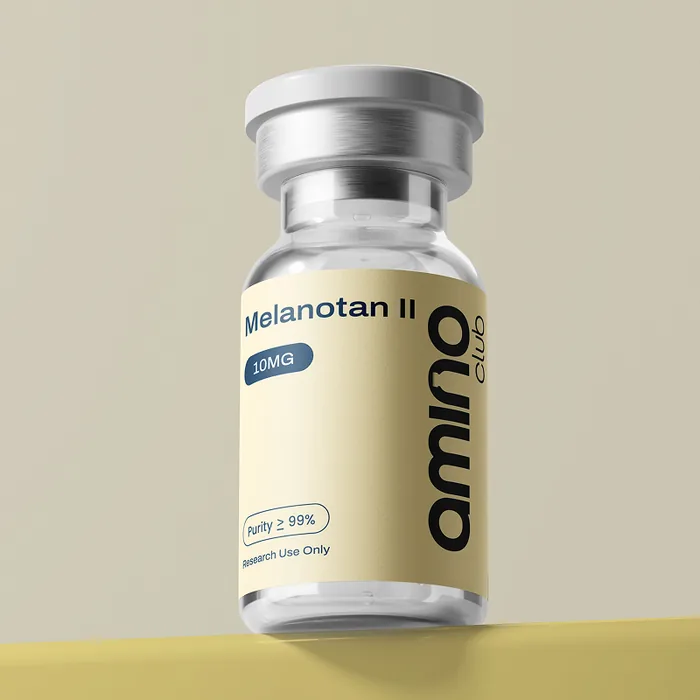
A cyclic alpha-MSH analogue that binds across the melanocortin receptor family rather than selecting one, which is both its value and its interpretive difficulty.
- Sequence
- Ac-Nle-cyclo[Asp-His-D-Phe-Arg-Trp-Lys]-NH2
- Molecular formula
- C50H69N15O9
- Molecular weight
- 1024.2 g/mol
- CAS number
- 121062-08-6
- Appearance
- white lyophilised powder
- Strength
- 10mg per vial
- Reference
- MT-2
- Purity
- ≥99% by HPLC, identity confirmed by mass spectrometry
- Released against
- the Certificate of Analysis for its own batch
About Melanotan II
Melanotan II is a synthetic cyclic heptapeptide analogue of alpha-melanocyte stimulating hormone. A lactam bridge between aspartate and lysine constrains the molecule into a conformation that resists enzymatic degradation and raises receptor affinity relative to the native hormone.
Its defining property is that it is non-selective. Alpha-MSH signals through five melanocortin receptor subtypes with different tissue distributions and functions: MC1R on melanocytes governs pigmentation, MC3R and MC4R are central and involved in energy balance and sexual behaviour, and MC5R is exocrine. Melanotan II binds MC1R, MC3R, MC4R and MC5R, which is why its research profile is broad and why attributing any single observation to one receptor is difficult without a selective comparator.
What the research covers
The oldest strand is pigmentation: MC1R agonism drives the switch from pheomelanin to eumelanin synthesis in melanocytes, the pathway the original Arizona research programme was built around. The strands that keep it in use are central: MC4R signalling in the hypothalamus in appetite regulation, and separately in the central component of sexual arousal.
That second observation led directly to PT-141, a metabolite of Melanotan II developed for MC4R and no longer studied for pigmentation at all. The design answer to Melanotan II’s promiscuity is to pair it with the MC1R-selective Melanotan I, so effects present with both can be attributed to MC1R. Published work is indexed on PubMed.
Handling Melanotan II
Supplied lyophilised. For a cyclic peptide, identity confirmation carries more weight than the purity figure: a linear sequence of identical amino acid composition has nearly the same mass and a materially different receptor profile, so confirming the lactam bridge is intact is the point of the analysis.
Reconstitute gently, store sealed at -20°C, and prepare working solutions fresh. Solvent options are under reconstitution supplies.
Other formats
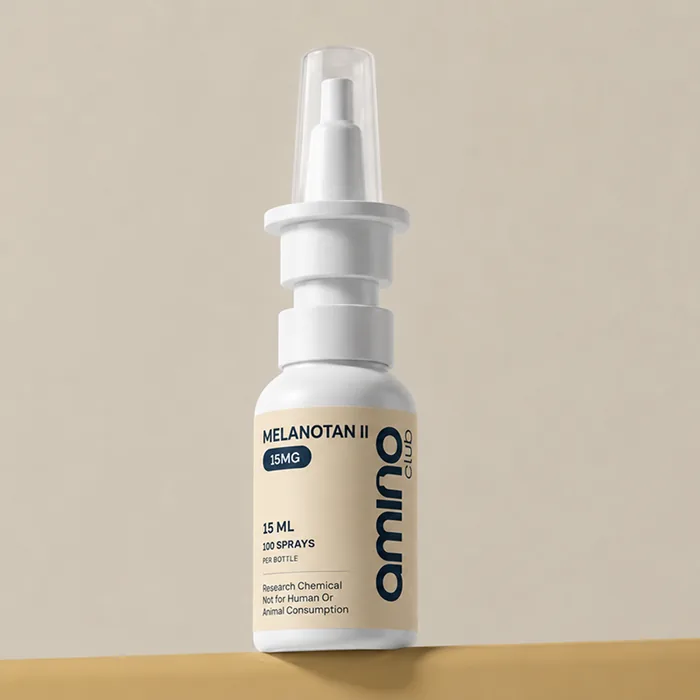
Melanotan II is also supplied as a metered 15ml Melanotan II nasal spray, where no reconstitution step is needed.
Common questions about Melanotan II
Which receptors does Melanotan II bind?
MC1R, MC3R, MC4R and MC5R. It is non-selective across the melanocortin family, unlike the MC1R-selective Melanotan I.
Why is Melanotan II cyclic?
A lactam bridge constrains its shape, which protects it from enzymatic breakdown and increases receptor affinity compared with alpha-MSH.
How is Melanotan II related to PT-141?
PT-141 is a metabolite of Melanotan II that was developed for its MC4R activity and is not studied for pigmentation.
How are its effects attributed to a specific receptor?
By pairing it with a selective agonist such as Melanotan I. Effects shared by both point to MC1R; effects unique to Melanotan II point elsewhere.
How should Melanotan II be stored?
Sealed vials at -20°C. Solutions are reconstituted gently and prepared fresh.