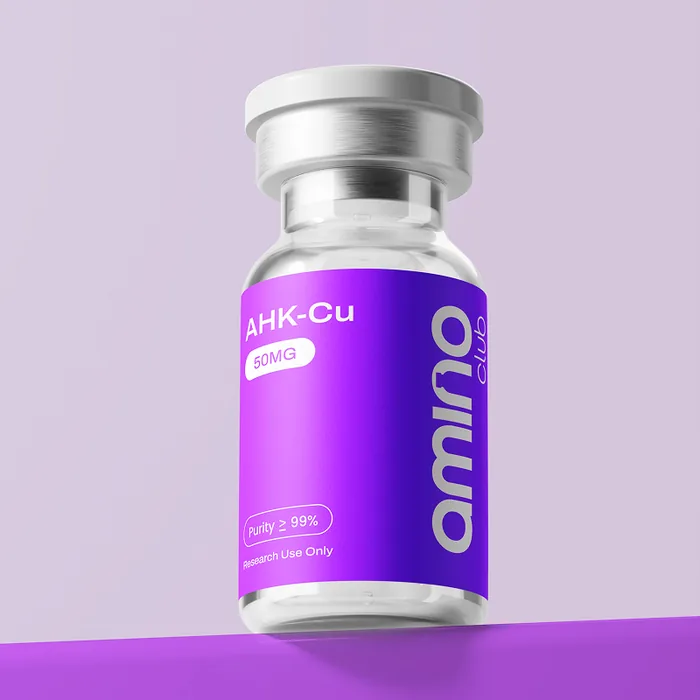
A copper tripeptide one residue away from GHK-Cu, with a much smaller research literature concentrated almost entirely on hair follicles.
- Sequence
- Ala-His-Lys (AHK), as the copper(II) complex
- Molecular formula
- C15H24CuN6O4 (complex, calculated); free AHK peptide C15H26N6O4
- Molecular weight
- approximately 415.9 g/mol (complex); 354.4 g/mol (free peptide)
- Appearance
- blue lyophilised powder
- Strength
- 50mg per vial
- Purity
- ≥99% by HPLC, identity confirmed by mass spectrometry
- Released against
- the Certificate of Analysis for its own batch
About AHK-Cu
AHK-Cu is alanyl-L-histidyl-L-lysine complexed with copper(II). The histidine imidazole and backbone nitrogens form the coordination site, and the complex is a defined chemical entity rather than a peptide with copper added alongside it. It differs from GHK-Cu by a single residue, alanine in place of glycine, and like GHK-Cu the active species is the complex rather than the free peptide.
That one-residue change gives the two complexes different stability constants and redox behaviour. Unlike GHK, AHK is synthetic rather than a naturally occurring plasma peptide. Copper is the functional reason these peptides exist: it is a required cofactor for lysyl oxidase, which cross-links collagen and elastin, and for superoxide dismutase, and the peptide essentially presents copper in a controlled form.
What the research covers
Work concentrates on the hair follicle: dermal papilla cell proliferation, vascular endothelial growth factor expression, and follicle size and growth phase in culture and animal models. That is a genuinely different focus from GHK-Cu, whose literature centres on dermal remodelling, gene expression and wound models. Whether the difference reflects distinct biology or simply where each compound happened to be studied is not resolved, and it is a reasonable question for a comparative design.
The two are routinely conflated in secondary sources, and a citation trail that mixes them is not evidence for either. One caution applies to both: copper complexes take part in redox chemistry, which in culture can generate reactive oxygen species or interfere with metal-sensitive assay reagents, effects that have nothing to do with the peptide. Copper-only controls are the standard precaution. Published work is indexed on PubMed.
Handling AHK-Cu
As with any copper tripeptide, the coordination complex is the species of interest, and it is light-sensitive and pH-dependent. Outside a fairly narrow pH range the geometry changes and the material in the vessel is no longer what the literature describes.
Protect from light, store cold and sealed, prepare solutions fresh, and treat loss of the characteristic blue colour as a reason to discard rather than proceed. Solvent options are under reconstitution supplies.
Common questions about AHK-Cu
How does AHK-Cu differ from GHK-Cu?
One residue: alanine replaces glycine. GHK-Cu occurs naturally and has a large dermal literature; AHK-Cu is synthetic and studied mainly in hair follicle models.
Why is the copper important?
The research concerns the copper complex, not the free peptide. Copper is a cofactor for enzymes such as lysyl oxidase, and the peptide holds it in a controlled form.
Can AHK-Cu and GHK-Cu be treated as interchangeable?
No. No interchangeability has been established, and evidence for one should not be cited as evidence for the other.
Why are copper-only controls needed?
Copper can produce reactive oxygen species or interfere with assay reagents in culture. A copper-only control separates those effects from the peptide’s.
How should AHK-Cu be stored?
Sealed, cold and protected from light. Solutions are prepared fresh and discarded if the blue colour fades.