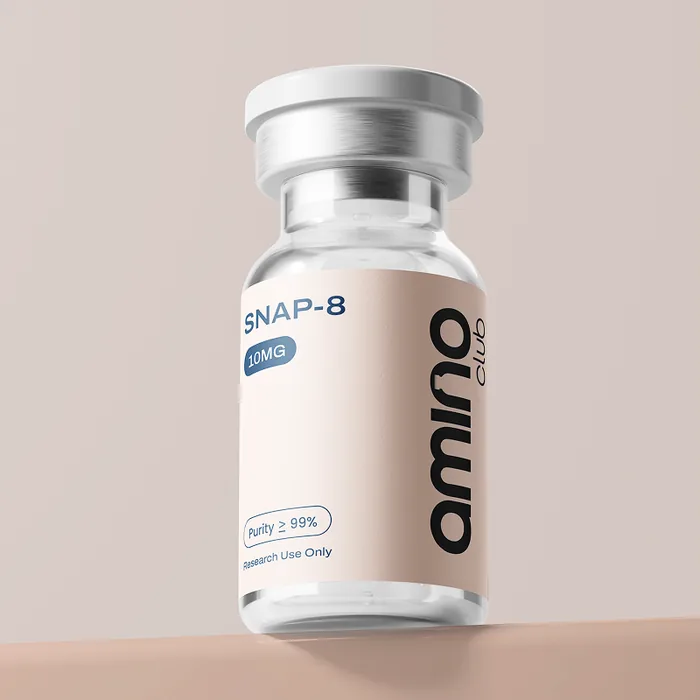
An eight-residue peptide studied for interfering with the SNARE complex, the machinery that docks neurotransmitter vesicles before release.
- Sequence
- Ac-Glu-Glu-Met-Gln-Arg-Arg-Ala-Asp-NH2
- Synonym
- acetyl octapeptide-3
- Molecular formula
- C41H70N16O16S
- Molecular weight
- 1075.2 g/mol
- CAS number
- 868844-74-0
- Appearance
- white lyophilised powder
- Strength
- 10mg per vial
- Purity
- ≥99% by HPLC, identity confirmed by mass spectrometry
- Released against
- the Certificate of Analysis for its own batch
About SNAP-8
Neurotransmitter release requires a vesicle to fuse with the membrane, and that fusion is driven by the SNARE complex, a bundle in which SNAP-25, syntaxin and VAMP wind together. Botulinum toxin disables it by cleaving SNAP-25. SNAP-8 reaches the same point by competition instead.
It is an octapeptide, acetylated at the N-terminus and amidated at the C-terminus, modelled on the N-terminal region of SNAP-25. Mimicking that region lets it compete for SNAP-25’s position in the complex, so the complex assembles less efficiently and release is reduced. No protein is cleaved and the effect is reversible. It extends the earlier hexapeptide of the same family by two residues, and in cosmetic nomenclature appears as acetyl octapeptide-3.
What the research covers
Work covers SNARE complex assembly in vitro, acetylcholine release at neuromuscular preparations, and dermal models where the readout is muscle contraction rather than matrix composition, which distinguishes it from the rest of this group. The in-vitro work is consistent with competitive interference in SNARE assembly.
The gap is delivery. The claimed effect on expression lines requires the peptide to reach a neuromuscular junction beneath the dermis, and an eight-residue hydrophilic peptide applied topically faces the stratum corneum, an effective barrier to exactly that class of molecule. Most supporting efficacy data comes from manufacturer studies rather than independent trials, and reported effects are modest. That makes penetration and formulation work a legitimate research question in its own right, and it is where much current interest sits. Published work is indexed on PubMed.
Handling SNAP-8
Supplied lyophilised. An octapeptide is adsorption-prone at low working concentration, and because the proposed mechanism is competitive, actual concentration at the target matters more than for a catalytic mechanism: a competitive inhibitor at half the intended concentration is half an experiment.
Use low-binding plasticware, prepare fresh, and verify dilutions rather than assuming them. The methionine residue is oxidation-prone, so limit air exposure of solutions. Store sealed vials at -20°C. Solvent options are under reconstitution supplies.
Common questions about SNAP-8
How does SNAP-8 work?
It mimics the N-terminal region of SNAP-25 and competes for its place in the SNARE complex, reducing the efficiency of vesicle fusion and neurotransmitter release.
How does it differ from botulinum toxin?
Botulinum toxin cleaves SNAP-25, disabling it. SNAP-8 competes with it reversibly and cleaves nothing, so its effect is far weaker.
Is SNAP-8 the same as acetyl octapeptide-3?
Yes. Acetyl octapeptide-3 is its cosmetic ingredient name.
What is the main open question in SNAP-8 research?
Delivery. Reaching nerve-muscle junctions beneath the dermis through intact skin is difficult for a hydrophilic peptide of this size.
How should SNAP-8 be stored?
Sealed vials at -20°C. Solutions are prepared fresh in low-binding plasticware and protected from air.