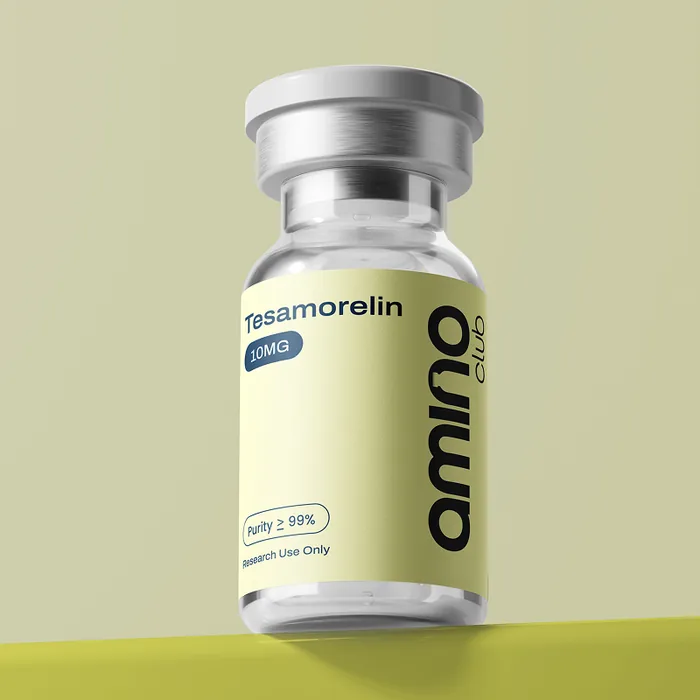
The full 44-residue GHRH sequence carrying a single fatty-acid group at the N-terminus, and the one GHRH analogue with controlled clinical literature behind its mechanism.
- Structure
- N-(trans-3-hexenoyl)-human GHRH(1-44)-NH2
- Molecular formula
- C221H366N72O67S
- Molecular weight
- 5135.9 g/mol
- CAS number
- 218949-48-5
- Appearance
- white lyophilised powder
- Strengths available
- 5mg, 10mg, 20mg per vial
- Purity
- ≥99% by HPLC, identity confirmed by mass spectrometry
- Released against
- the Certificate of Analysis for its own batch
About Tesamorelin
Tesamorelin is the complete 44-residue human GHRH sequence with a trans-3-hexenoyl group attached to the N-terminus. That small acyl addition sits exactly where dipeptidyl peptidase-4 would cut, so it extends circulating life without an albumin anchor and without altering the receptor-binding surface.
Three stabilisation strategies exist side by side in this class, and the distinction is worth holding onto when reading the literature: truncate the sequence, as Sermorelin does; substitute the vulnerable residues, as the CJC-1295 series does; or shield them with an acyl group. Tesamorelin is the third, and it is also the full-length sequence rather than the 29-residue fragment most analogues use.
What the research covers
Most compounds in a research catalogue rest on cell culture and animal work. Tesamorelin carries controlled clinical trial data, and the finding that distinguishes it is a selective association with visceral rather than subcutaneous adipose tissue, a compartment specificity that does not follow from the general growth hormone literature. That gives a laboratory a comparator whose downstream effects have been characterised in people as well as in culture. It does not license extrapolation: the clinical work used defined preparations under medical supervision, and none of it transfers to a research-grade vial.
Research strands cover GHRH receptor agonism and the growth hormone and IGF-1 axis, visceral adipose biology, hepatic lipid content, and the comparative pharmacology of acylated against substituted analogues. Comparison against Sermorelin isolates what the stabilising group contributes. Published work is indexed on PubMed.
Handling Tesamorelin
Supplied lyophilised. The hexenoyl group gives the molecule amphipathic character, which makes it more surface-active than the unmodified fragment: it adsorbs to interfaces and foams more readily on agitation.
Direct solvent down the vial wall and swirl only. Vigorous mixing costs material at the air-liquid interface rather than merely looking untidy. Store sealed vials at -20°C. Solvent options are under reconstitution supplies.
Common questions about Tesamorelin
How does Tesamorelin differ from Sermorelin?
Sermorelin is the first 29 residues of GHRH with no protection against DPP-4. Tesamorelin is the full 44 residues with a hexenoyl group shielding the cleavage site, which gives it a much longer circulating life.
What does the hexenoyl group do?
It blocks the site where dipeptidyl peptidase-4 cleaves GHRH, extending half-life without changing how the peptide binds its receptor.
Why is its visceral fat literature notable?
Controlled clinical work associated it selectively with visceral rather than subcutaneous adipose tissue. That compartment specificity is unusual and is not predicted by the general growth hormone literature.
Does the clinical data apply to research-grade material?
No. The clinical studies used defined pharmaceutical preparations under medical supervision. They provide mechanistic reference points, not grounds for extrapolating to a research vial.
How should Tesamorelin be stored?
Sealed vials at -20°C. Reconstitute by directing solvent down the vial wall and swirling, never shaking, because the acylated peptide is surface-active.