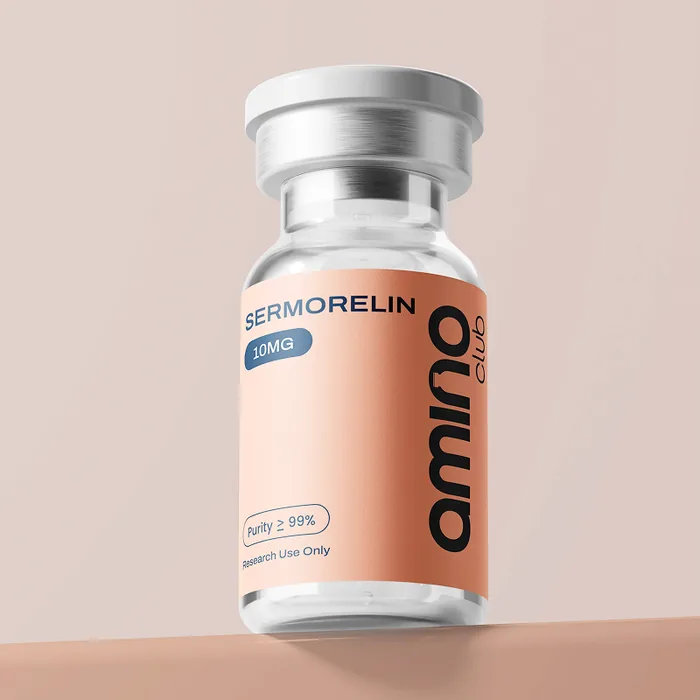
GHRH(1-29) itself: the shortest fragment of growth hormone releasing hormone that retains full activity, and the unmodified reference for the whole analogue class.
- Sequence
- human GHRH(1-29)-NH2: Tyr-Ala-Asp-Ala-Ile-Phe-Thr-Asn-Ser-Tyr-Arg-Lys-Val-Leu-Gly-Gln-Leu-Ser-Ala-Arg-Lys-Leu-Leu-Gln-Asp-Ile-Met-Ser-Arg-NH2
- Molecular formula
- C149H246N44O42S
- Molecular weight
- 3357.9 g/mol
- CAS number
- 86168-78-7
- Appearance
- white lyophilised powder
- Strengths available
- 5mg, 10mg per vial
- Purity
- ≥99% by HPLC, identity confirmed by mass spectrometry
- Released against
- the Certificate of Analysis for its own batch
About Sermorelin
Native growth hormone releasing hormone is 44 residues long. Sermorelin is the first 29, with no stabilising substitutions, and work in the 1980s established that this fragment carries essentially all of the biological activity. The remaining fifteen residues contribute to stability and clearance rather than receptor engagement, which is why the compound is often written GRF(1-29) and why every analogue in the class is built on it.
It acts on the GHRH receptor of pituitary somatotrophs, a class-B G-protein-coupled receptor signalling through Gs, adenylate cyclase and cyclic AMP. The limitation is at position two: alanine there is the preferred substrate of dipeptidyl peptidase-4, which removes the first two residues within minutes. Every later analogue, from the substituted CJC-1295 series to the acylated Tesamorelin, is an answer to that single vulnerability.
What the research covers
Rapid clearance is a defect in a therapeutic and often a feature in an experiment. Exposure tracks the administration profile closely, so Sermorelin is the cleanest tool for studying a defined pulse of GHRH signalling and then its absence. It also works through the pituitary rather than around it: feedback from somatostatin and IGF-1 stays intact, which makes it a probe of pituitary responsiveness in a way that somatropin, which bypasses the gland, cannot be.
It is the native-kinetics baseline in comparisons with modified GRF(1-29) and the DAC form, and the only way to isolate what the four substitutions and the albumin anchor actually contribute. Against a ghrelin receptor agonist such as Ipamorelin it engages a different receptor on the same cell, and the two are synergistic in published work. Published work is indexed on PubMed.
Handling Sermorelin
Supplied lyophilised. The vulnerability here is enzymatic rather than chemical: DPP-4 is present in serum and in many cell culture systems, so a preparation can be degraded by the experimental matrix rather than by storage. That is a design consideration as much as a handling one.
Store sealed at -20°C, reconstitute gently, and account for matrix proteolysis when interpreting a shorter-than-expected response. Solvent options are under reconstitution supplies.
Common questions about Sermorelin
What does GRF(1-29) mean?
Growth hormone releasing factor, residues 1 to 29. It is the first 29 of the 44 residues of native GHRH, which carry essentially all of its activity at the receptor.
Why is its half-life so short?
Dipeptidyl peptidase-4 cleaves the first two residues, at the alanine in position two, within minutes. Sermorelin has no substitution protecting that site.
How does Sermorelin differ from CJC-1295?
CJC-1295 is the same 29-residue backbone with four substitutions that resist DPP-4, and in its DAC form an albumin-binding group as well. Sermorelin is the unmodified reference they are measured against.
Why is it used to test pituitary responsiveness?
It stimulates the pituitary while leaving its feedback controls intact, so the response shows what the gland itself is capable of. Somatropin bypasses the gland and cannot answer that question.
How should Sermorelin be stored?
Sealed vials at -20°C. Solutions are reconstituted gently, kept cold and used promptly, with DPP-4 activity in the experimental matrix accounted for.