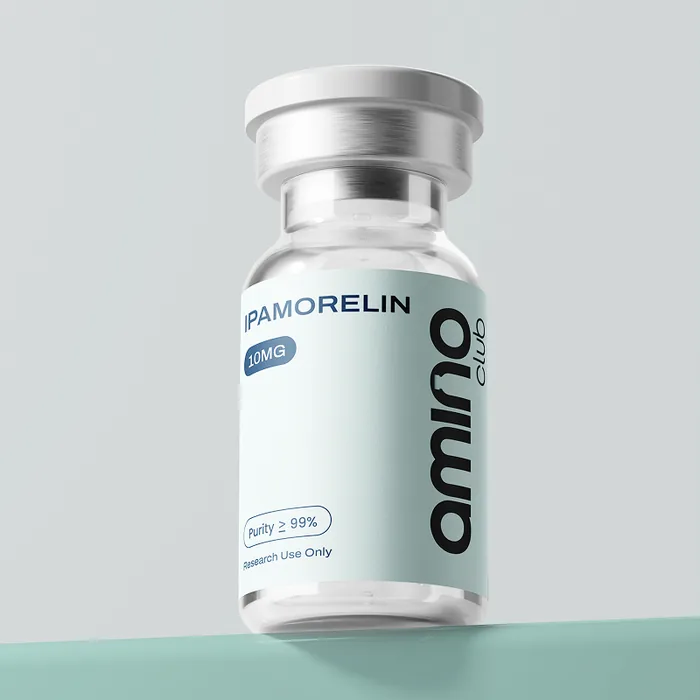
The selective end of the secretagogues: less growth hormone released than GHRP-2, and far less of everything else.
- Sequence
- Aib-His-D-2-Nal-D-Phe-Lys-NH2
- Molecular formula
- C38H49N9O5
- Molecular weight
- 711.9 g/mol
- CAS number
- 170851-70-4
- Appearance
- white lyophilised powder
- Strengths available
- 2mg, 5mg, 10mg per vial
- Purity
- ≥99% by HPLC, identity confirmed by mass spectrometry
- Released against
- the Certificate of Analysis for its own batch
About Ipamorelin
Ipamorelin is a synthetic pentapeptide, Aib-His-D-2-Nal-D-Phe-Lys-NH2, and an agonist at GHSR-1a. That is the receptor for ghrelin, and a different target from the GHRH receptor that CJC-1295 and Sermorelin act on.
Its significance is selectivity, not potency. The earlier secretagogues of this class, GHRP-2 and Hexarelin, produce measurable increases in cortisol, prolactin and ACTH alongside growth hormone. Ipamorelin was developed to reduce that cross-activity, and at research concentrations it largely achieves that. It releases less growth hormone than either in exchange, and that trade is the reason the compound exists.
What the research covers
Cortisol confounds a long list of metabolic, immune and behavioural endpoints. Where the objective is to assign an observation to growth hormone signalling specifically, a cleaner releaser is worth more than a stronger one, and it removes the need for additional controls. Where maximum release is the objective, or off-target activity is itself the subject, GHRP-2 or Hexarelin are the better fit.
Because GHSR-1a and the GHRH receptor are independent, Ipamorelin is also the secretagogue of choice for combination work with a GHRH analogue: activating both produces a larger response than either gives alone. Published work is indexed on PubMed.
Handling Ipamorelin
Supplied lyophilised. The sequence contains two D-amino acids and a C-terminal amide, none of which arise by default in peptide synthesis, so mass spectrometric identity confirmation is doing substantive work here rather than serving as a formality.
Robust dry and adsorption-prone dilute, as with the other short secretagogues. Store sealed at -20°C and prepare working solutions fresh. Solvent options are under reconstitution supplies.
Common questions about Ipamorelin
How does Ipamorelin differ from GHRP-2?
Both are GHSR-1a agonists. GHRP-2 releases more growth hormone but also raises cortisol, prolactin and ACTH. Ipamorelin releases less but with far less of that cross-activity.
Why does selectivity matter in a study?
If a compound raises cortisol alongside growth hormone, any endpoint cortisol also affects becomes difficult to attribute. A selective releaser keeps the observation tied to growth hormone signalling.
Which receptor does Ipamorelin act on?
GHSR-1a, the ghrelin receptor. That is a separate receptor from the GHRH receptor targeted by Sermorelin, Tesamorelin and CJC-1295.
Why is it combined with GHRH analogues?
The two receptors are independent, so activating both produces a larger growth hormone response than either alone. Mechanistic work runs the single agents alongside any combination so effects can be attributed.
How should Ipamorelin be stored?
Sealed vials at -20°C. Working solutions are prepared fresh and kept at concentrations high enough that surface adsorption does not dominate.