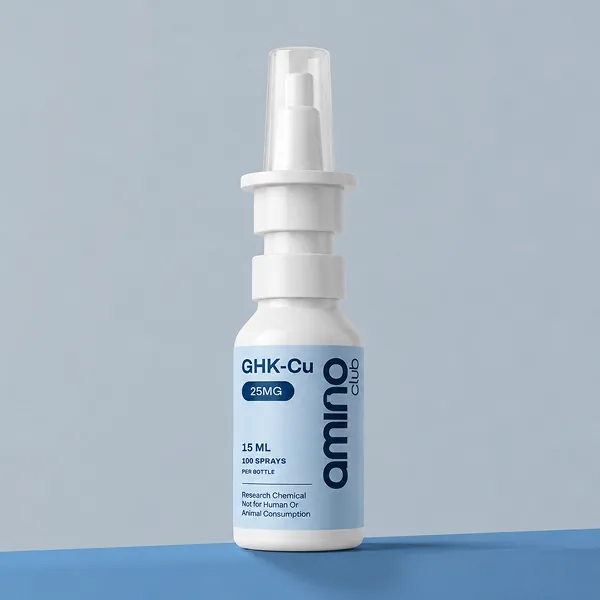
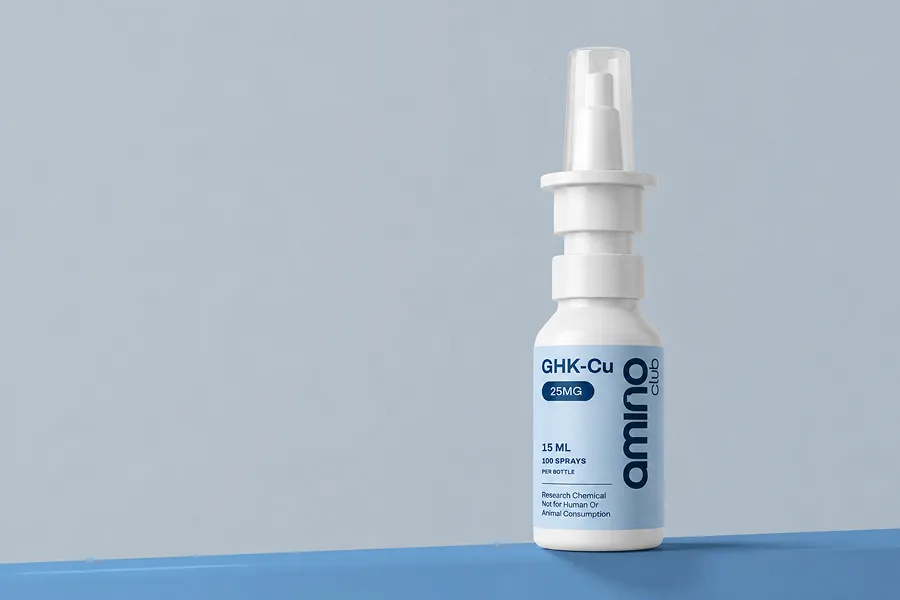
The copper tripeptide supplied already in solution at a verified concentration — which for a pH-sensitive coordination complex is more useful than it sounds.
- Contains
- GHK-Cu (sequence, formula and CAS number are on the vial product page)
- Content
- 25mg in a metered 25ml bottle
- Presentation
- ready-to-use metered intranasal solution; no reconstitution step
- Purity
- ≥99% by HPLC, identity confirmed by mass spectrometry
- Released against
- the Certificate of Analysis for its own batch
About GHK-Cu Nasal Spray
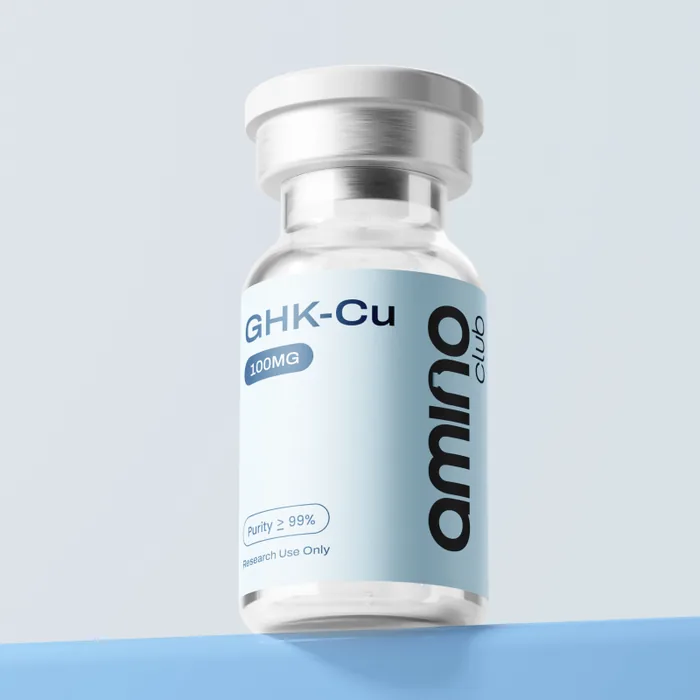
This is GHK-Cu, the copper(II) complex of glycyl-L-histidyl-L-lysine, supplied in a metered 25ml intranasal bottle. The compound matches the vial presentation; the difference is that it arrives in solution.
For this particular compound that is a more substantial advantage than for most. The active species is a coordination complex whose integrity depends on pH, so a preparation buffered and verified before dispatch removes the most common way a GHK-Cu experiment goes wrong.
What the research covers
The research context is the same as for the vial: transcriptional profiling, collagen and glycosaminoglycan synthesis, metalloproteinase balance and copper delivery to cuproenzymes. The GHK-Cu page covers the literature.
Where the follicular question is the one being asked, AHK-Cu has the more directly relevant evidence — see the comparison. The skin and cosmetic research peptides hub covers the three mechanisms in this group.
Handling GHK-Cu Nasal Spray
Supplied as a metered preparation, so no reconstitution step is needed and the pH is already set.
Light protection remains essential: the copper complex is photosensitive in solution as much as in the dry state. Store cold, upright and dark, and treat any loss of the characteristic blue colour as a reason to discard the bottle rather than continue with it.
Other formats
The same compound is supplied as a lyophilised GHK-Cu vial, which gives control over concentration that a fixed solution cannot.
Common questions about GHK-Cu Nasal Spray
Is this the same compound as the GHK-Cu vial?
Yes. The compound is identical; it is supplied already in solution in a metered intranasal bottle instead of as a lyophilised powder.
When is the nasal spray the better choice?
When the intranasal route is itself part of the study design, or when consistency between sessions matters more than control over concentration.
When is the vial the better choice?
When the protocol needs to set its own concentration or run dose-ranging. A fixed-concentration solution cannot be varied.
How long does the spray remain usable?
A peptide in solution has a shorter usable life than a sealed lyophilised vial. Keep the bottle cold, upright and protected from light, and treat its life as limited.