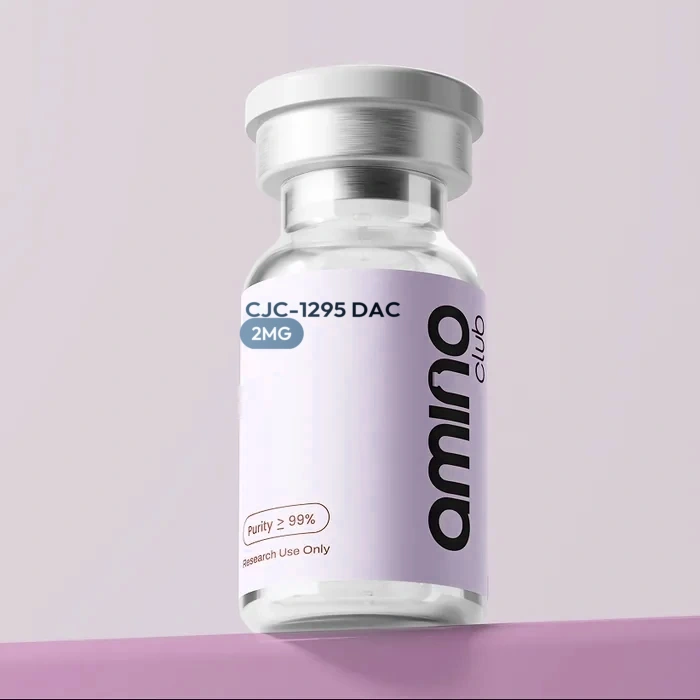
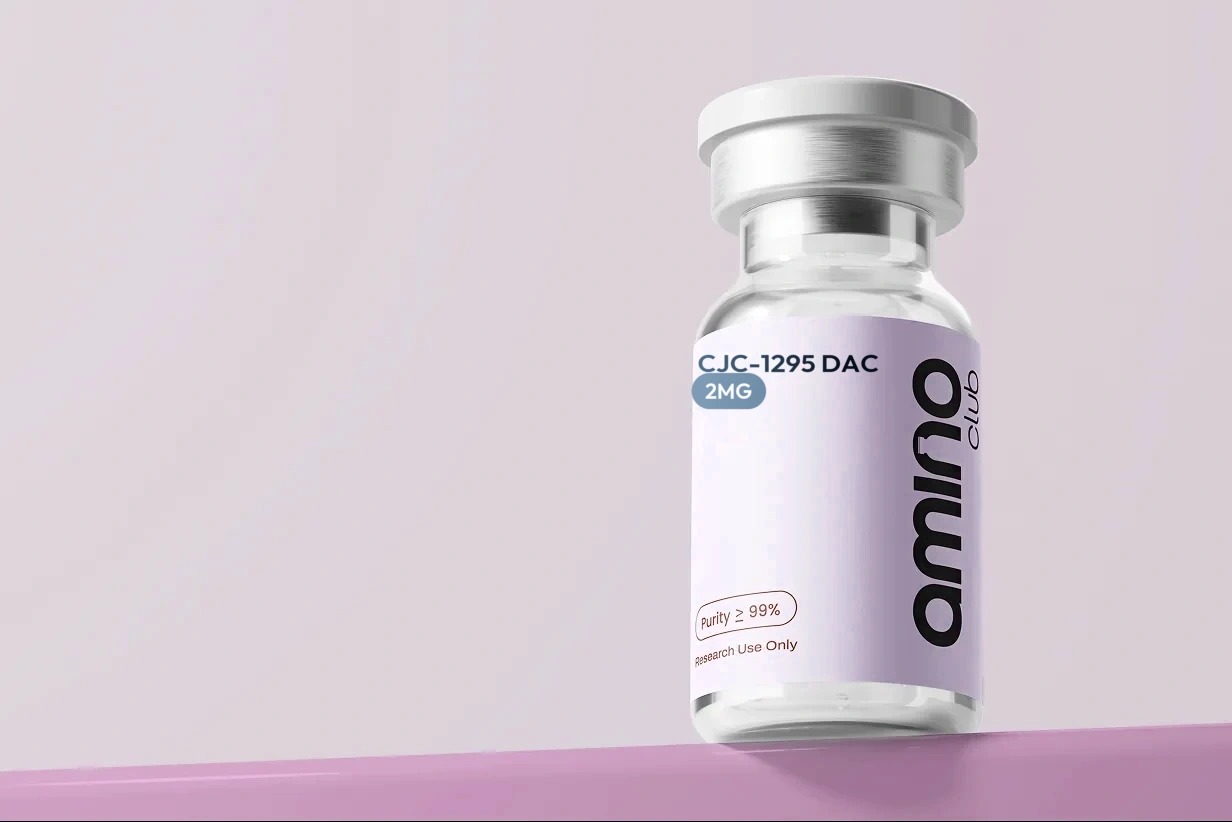
The same 29-residue GHRH analogue as the non-DAC form, with one addition that stretches its half-life from about half an hour to several days.
- Structure
- modified GRF(1-29) (D-Ala2, Gln8, Ala15, Leu27) with C-terminal Lys(maleimidopropionyl) drug affinity complex
- Molecular formula
- C165H269N47O46
- Molecular weight
- 3647.2 g/mol
- Appearance
- white lyophilised powder
- Strengths available
- 2mg, 5mg, 10mg per vial
- Purity
- ≥99% by HPLC, identity confirmed by mass spectrometry
- Released against
- the Certificate of Analysis for its own batch
About CJC-1295 with DAC
CJC-1295 is built on the first 29 residues of growth hormone releasing hormone, the shortest fragment with full activity, with four substitutions (D-Ala2, Gln8, Ala15 and Leu27) that resist dipeptidyl peptidase-4 cleavage. This form adds a drug affinity complex: a lysine carrying a maleimidopropionic acid group, which forms a covalent bond with cysteine-34 on serum albumin. Albumin circulates for weeks, so the bound peptide persists far beyond what the sequence alone permits.
It acts at the GHRH receptor on pituitary somatotrophs, amplifying the endogenous pulse rather than replacing it, so the pituitary stays in the loop and feedback regulation is preserved. Receptor target and binding are unchanged from the non-DAC form: this is a pharmacokinetic modification, not a pharmacodynamic one.
What the research covers
The DAC form suits designs where sustained GHRH receptor occupancy is wanted and infrequent intervention is an advantage: multi-day or multi-week observation, downstream IGF-1 as an endpoint, and work on the consequences of flattening rather than amplifying the growth hormone pulse.
It is the wrong tool for pulsatility work, and it cannot be meaningfully paired with a short-acting secretagogue, because there is no peak to align a second peak to. Those designs need the form without DAC. Published work is indexed on PubMed.
Handling CJC-1295 with DAC
Supplied lyophilised. The maleimide group is the part that needs care: it is the reactive handle that forms the albumin bond, and it hydrolyses in aqueous solution.
Solutions should therefore be prepared immediately before use rather than stored. A hydrolysed maleimide leaves a peptide that no longer binds albumin and behaves as the non-DAC form instead, a silent conversion that will look like a kinetics result. Store sealed vials at -20°C. Solvent options are under reconstitution supplies.
Common questions about CJC-1295 with DAC
What does the DAC do?
The drug affinity complex forms a covalent bond with serum albumin. Because albumin circulates for weeks, the attached peptide persists for days instead of about half an hour.
How can the two forms be told apart?
By mass. The DAC form weighs 3647.2 g/mol and the form without DAC 3367.9 g/mol, which mass spectrometry distinguishes clearly. CAS numbers are not a reliable guide, as suppliers apply the same number to both.
Why is it unsuitable for pulsatility studies?
It produces a sustained elevation rather than a discrete pulse, so it cannot reveal anything about the timing or shape of growth hormone release.
Why is it not paired with short-acting secretagogues?
Combination designs depend on two peaks coinciding. A sustained-release analogue has no peak to align with, which is why combinations use the form without DAC.
How should it be stored?
Sealed vials at -20°C. Solutions are made immediately before use, because the maleimide group hydrolyses in water.