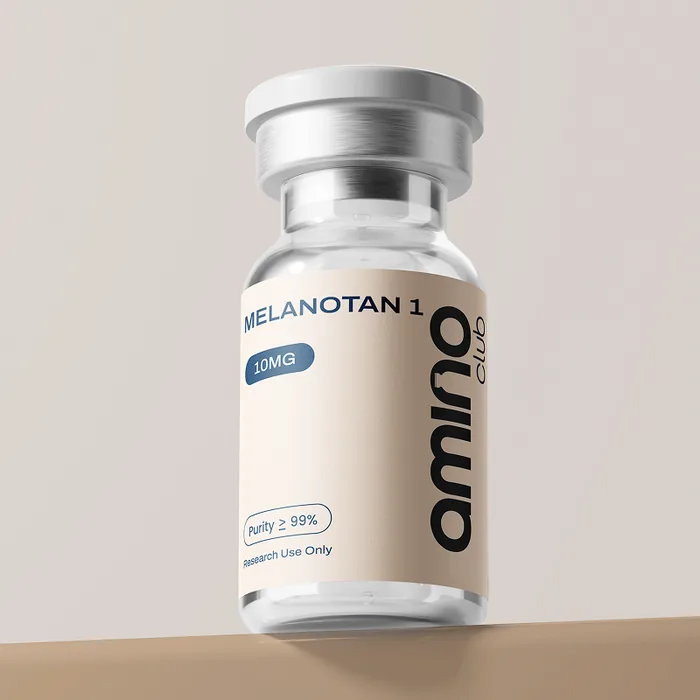
The selective one: a linear alpha-MSH analogue weighted to MC1R, which is what makes a pigmentation result attributable.
- Sequence
- Ac-Ser-Tyr-Ser-Nle-Glu-His-D-Phe-Arg-Trp-Gly-Lys-Pro-Val-NH2
- Synonym
- afamelanotide
- Molecular formula
- C78H111N21O19
- Molecular weight
- 1646.9 g/mol
- CAS number
- 75921-69-6
- Appearance
- white lyophilised powder
- Strength
- 10mg per vial
- Reference
- MT-1
- Purity
- ≥99% by HPLC, identity confirmed by mass spectrometry
- Released against
- the Certificate of Analysis for its own batch
About Melanotan I
Alpha-melanocyte stimulating hormone is thirteen residues long and cleared within minutes. Melanotan I, also known as afamelanotide, is the same sequence with two changes: norleucine replacing methionine at position 4, and D-phenylalanine replacing the L form at position 7. Both substitutions block degradation, and the D residue also locks a conformation the receptor prefers, so potency rises as well as duration.
Critically, the molecule remains linear and selective. It is an agonist at MC1R, the melanocortin receptor on melanocytes that drives eumelanin synthesis, with materially less central MC3R and MC4R activity. That is the whole difference from Melanotan II, which is cyclic and non-selective, and the two should not be conflated. It is also the one compound of the pair with a regulatory approval, as afamelanotide for erythropoietic protoporphyria, a rare light-sensitivity condition, which makes its MC1R mechanism unusually well supported.
What the research covers
Work concentrates on MC1R signalling through cyclic AMP and the microphthalmia-associated transcription factor, eumelanin versus pheomelanin synthesis, and photoprotection measured as minimal erythema dose. MC1R polymorphism, the genetic basis of red hair and fair skin, is a further strand that determines how much response is possible in a given cell line.
Its research value is attributional. An effect observed with a receptor-selective agonist can be assigned to that receptor; the same effect with a pan-melanocortin agonist cannot. Running it alongside Melanotan II is the standard way to separate MC1R effects from the rest. Published work is indexed on PubMed.
Handling Melanotan I
Supplied lyophilised. Being linear rather than cyclic, this analogue is somewhat more susceptible to proteolysis than Melanotan II, though its substitutions give it far more stability than native alpha-MSH.
Standard care applies: gentle reconstitution, cold sealed storage at -20°C, solutions prepared fresh, and protection from prolonged light exposure. Solvent options are under reconstitution supplies.
Common questions about Melanotan I
Is Melanotan I the same as afamelanotide?
Yes. Afamelanotide is its international non-proprietary name.
How does Melanotan I differ from Melanotan II?
Melanotan I is linear and selective for MC1R, the pigmentation receptor. Melanotan II is cyclic and binds across MC1R, MC3R, MC4R and MC5R.
Why does receptor selectivity matter?
An effect produced by a selective agonist can be attributed to its receptor. With a non-selective agonist, several receptors could be responsible.
What does MC1R polymorphism have to do with it?
Variants of MC1R, behind red hair and fair skin, change how strongly cells can respond, so the cell line or model chosen affects the result.
How should Melanotan I be stored?
Sealed vials at -20°C, protected from light. Solutions are reconstituted gently and prepared fresh.