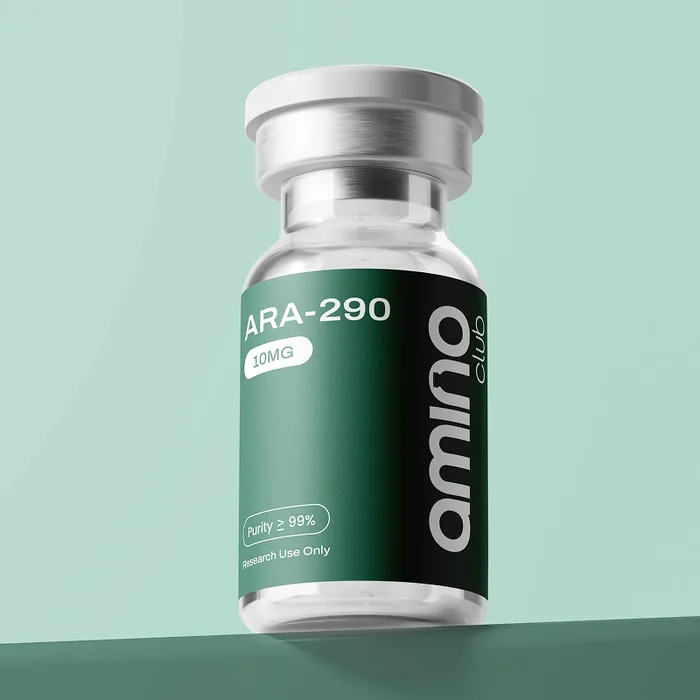
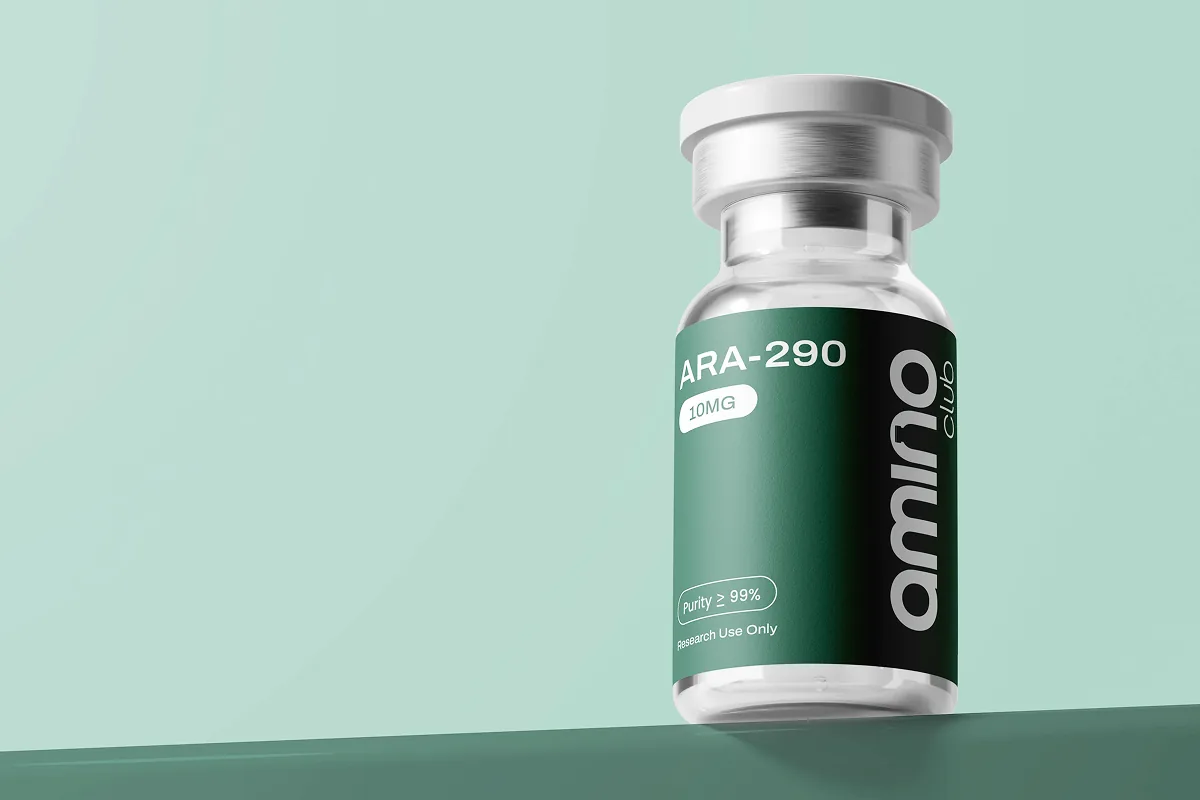
An eleven-residue fragment of erythropoietin that keeps the tissue-protective signalling and loses the effect on red cell production entirely.
- Sequence
- pGlu-Glu-Gln-Leu-Glu-Arg-Ala-Leu-Asn-Ser-Ser (pyroglutamate N-terminus)
- Synonym
- cibinetide
- Molecular formula
- C51H84N16O21
- Molecular weight
- 1257.3 g/mol
- CAS number
- 1208243-50-8
- Appearance
- white lyophilised powder
- Strengths available
- 10mg, 16mg per vial
- Purity
- ≥99% by HPLC, identity confirmed by mass spectrometry
- Released against
- the Certificate of Analysis for its own batch
About ARA-290
ARA-290, also called cibinetide, is an eleven-residue peptide derived from helix B of erythropoietin. Erythropoietin does two unrelated things: it drives red blood cell production through the classical EPO receptor homodimer, and it protects tissue through a different assembly, a heterocomplex of the EPO receptor with the common beta receptor (CD131), usually called the innate repair receptor.
The two activities map to different faces of the molecule. ARA-290 reproduces the face that engages the protective receptor and does not engage the erythropoietic one, so it signals tissue protection without raising haematocrit. That separation is the entire purpose of the molecule.
What the research covers
For an experimentalist, ARA-290 is less interesting as a repair peptide than as a dissociation tool. If an effect of erythropoietin persists with ARA-290, it belongs to the innate repair receptor; if it disappears, it belonged to the classical receptor or the haematological change downstream of it. Few compounds let a question be partitioned that cleanly, and full-length erythropoietin is the informative control.
Published work concentrates on neuropathic and small-fibre neuropathy models, corneal nerve endpoints, inflammatory signalling and macrophage phenotype, and ischaemia-reperfusion injury. There is also phase 2 clinical literature, uncommon in this catalogue, which constrains the mechanism more tightly than cell work alone. Compared with BPC-157 and TB-500, which act broadly through mechanisms still under debate, ARA-290 has an unusually well-specified target. Published work is indexed on PubMed.
Handling ARA-290
Supplied lyophilised. An eleven-residue peptide is adsorption-prone at the low working concentrations typical of cytoprotection assays, and that loss is systematic rather than random.
Reconstitute gently, use low-binding plasticware where the protocol allows, and prepare working solutions fresh rather than diluting from a stored stock. Store sealed vials at -20°C. Solvent options are under reconstitution supplies.
Common questions about ARA-290
Is ARA-290 the same as cibinetide?
Yes. Cibinetide is its international non-proprietary name; ARA-290 is its development code.
Does ARA-290 affect red blood cell production?
No. It engages the tissue-protective innate repair receptor and not the classical EPO receptor that drives red cell production.
What is the innate repair receptor?
A heterocomplex of the EPO receptor with the common beta receptor (CD131), distinct from the EPO receptor homodimer responsible for erythropoiesis.
Why is it useful as a research tool?
It separates erythropoietin’s two activities. Comparing it with full-length erythropoietin shows which receptor an observed effect depends on.
How should ARA-290 be stored?
Sealed vials at -20°C. Working solutions are prepared fresh in low-binding plasticware.