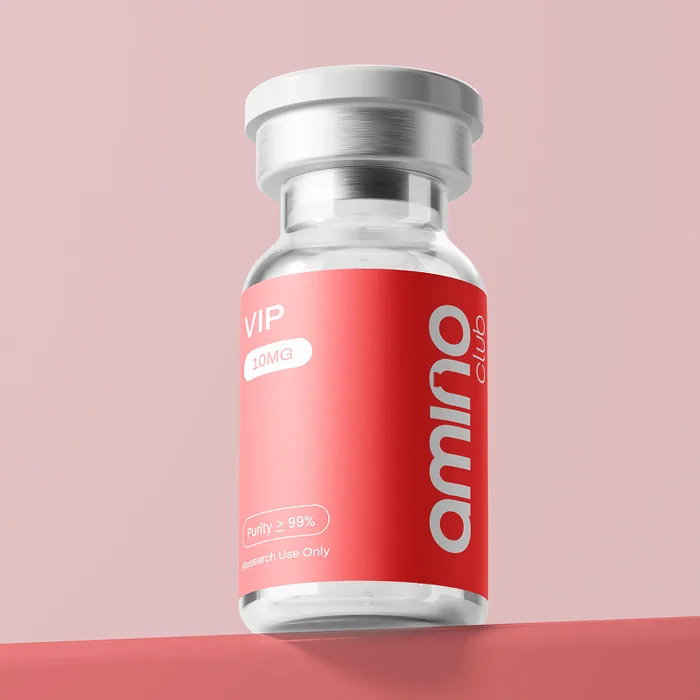
A 28-residue neuropeptide acting at two class B receptors: vasodilator, immunomodulator and circadian signal, depending on the tissue.
- Sequence
- HSDAVFTDNYTRLRKQMAVKKYLNSILN-NH2 (human)
- Molecular formula
- C147H238N44O42S
- Molecular weight
- 3325.8 g/mol
- CAS number
- 40077-57-4
- Appearance
- white lyophilised powder
- Strength
- 10mg per vial
- Reference
- VP10
- Purity
- ≥99% by HPLC, identity confirmed by mass spectrometry
- Released against
- the Certificate of Analysis for its own batch
About VIP
Vasoactive intestinal peptide is a 28-residue peptide of the glucagon-secretin superfamily, which places it structurally alongside GHRH and PACAP. It was isolated from intestinal tissue and named for its vasodilatory effect, a description that has aged poorly given how much else it does.
It acts at two class B G-protein coupled receptors, VPAC1 and VPAC2, both coupling principally to Gs and cyclic AMP, with different tissue distributions. In the body it functions as a neurotransmitter in the enteric and central nervous systems, a regulator of secretion and smooth muscle tone, an immune modulator, and the principal signalling peptide coordinating neurons of the suprachiasmatic nucleus, the circadian pacemaker. The native peptide does not distinguish between the two receptors, which is why it is usually the non-selective reference in work that needs the distinction made.
What the research covers
Research strands follow the receptors. The immunological literature, tending towards VPAC1, treats VIP as an endogenous anti-inflammatory signal: it shifts cytokine profiles away from the inflammatory pattern, influences regulatory T cell populations and dampens macrophage activation. Pulmonary and gastrointestinal models appear throughout.
The circadian literature is separate and does not translate across. VPAC2 signalling is required for the suprachiasmatic nucleus to maintain a coherent rhythm, and VIP-deficient animals show disorganised rather than merely shifted rhythms. Attributing an effect to one receptor requires a selective analogue or a receptor knockout comparator, and an experiment in one field should be read against that field, since receptor, tissue and concentration ranges differ. Published work is indexed on PubMed.
Handling VIP
Supplied lyophilised. A 28-residue peptide with substantial helical content is more fragile in solution than the short fragments in this group, and it is prone to both aggregation and oxidation at its methionine residue.
Reconstitute gently, avoid shaking, keep solutions cold and freshly prepared, and limit exposure to air where the protocol allows: methionine oxidation changes the molecule without changing its mass appreciably. Store sealed vials at -20°C. Solvent options are under reconstitution supplies.
Common questions about VIP
What does VIP stand for?
Vasoactive intestinal peptide, named for the vasodilation first observed in intestinal tissue. Its functions turned out to extend well beyond that.
Which receptors does VIP act on?
VPAC1 and VPAC2, two class B G-protein coupled receptors with different tissue distributions. Native VIP activates both.
Why does VIP appear in both immunology and circadian research?
Its immune effects run largely through VPAC1 and its role in the brain’s circadian pacemaker through VPAC2. The two literatures involve different receptors and tissues.
How is a VPAC1 or VPAC2 effect isolated?
With a receptor-selective analogue or a receptor knockout comparator, since native VIP engages both.
How should VIP be stored?
Sealed vials at -20°C. Solutions are prepared fresh, kept cold, not shaken, and protected from air to limit methionine oxidation.