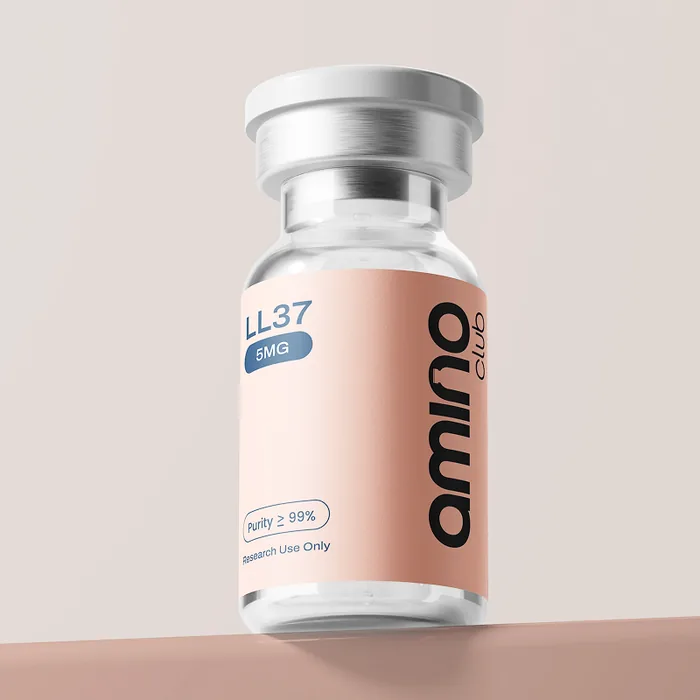
The only human cathelicidin: a 37-residue cationic peptide that kills bacteria by disrupting membranes and signals to host cells as well.
- Sequence
- LLGDFFRKSKEKIGKEFKRIVQRIKDFLRNLVPRTES
- Molecular formula
- C205H340N60O53
- Molecular weight
- 4493.3 g/mol
- CAS number
- 154947-66-7
- Appearance
- white lyophilised powder
- Strength
- 5mg per vial
- Reference
- LL-37
- Purity
- ≥99% by HPLC, identity confirmed by mass spectrometry
- Released against
- the Certificate of Analysis for its own batch
About LL-37
LL-37 is 37 residues long and begins with two leucines, which is where the name comes from. It is the mature product of the human cathelicidin gene CAMP, released by proteolysis from a precursor stored in neutrophil granules and produced by epithelium at barrier surfaces. Humans have exactly one cathelicidin, where other mammals have several.
Structurally it is amphipathic: on meeting a membrane it folds into a helix with charged residues on one face and hydrophobic residues on the other. The cationic face is drawn to the anionic surface of a bacterial membrane, the hydrophobic face inserts, and the membrane loses integrity. Because the target is a physical property of the membrane rather than a protein, resistance develops far less readily than against conventional antibiotics. It is also a host signalling molecule, binding formyl peptide receptor 2, which is why it sits in a tissue repair group rather than only a microbiology one.
What the research covers
Work divides between its two roles: membrane permeabilisation, antimicrobial spectrum and antibiofilm activity on one side, and on the other FPR2-mediated signalling, chemotaxis of neutrophils, monocytes and T cells, dendritic cell maturation, angiogenesis and wound re-epithelialisation. Its role in chronic inflammatory skin conditions is a third strand, in which it is reported as both protective and pathogenic depending on context.
Concentration dependence is unusually stark. The same peptide is antimicrobial, immunomodulatory and cytotoxic to host cells across different ranges, so a micromolar result and a nanomolar one are not describing the same mechanism, and a result without a concentration series is close to uninterpretable. Physiological salt also substantially reduces membrane activity, so antimicrobial results from low-salt buffer need careful reading. Published work is indexed on PubMed.
Handling LL-37
This peptide’s handling does not generalise from the rest of the catalogue. Being strongly cationic, it binds avidly to glass and to standard polypropylene, and losses from a dilute solution can be severe enough to invalidate a concentration series. Low-binding plasticware is effectively mandatory rather than advisable.
It is also sensitive to ionic strength and to divalent cations, which antagonise its membrane activity, so buffer composition is an experimental variable rather than a background detail. Store sealed vials at -20°C. Solvent options are under reconstitution supplies.
Common questions about LL-37
Why is it called LL-37?
It is 37 amino acids long and its first two residues are leucines (L, L).
How does LL-37 kill bacteria?
Its helix has a positively charged face, attracted to negatively charged bacterial membranes, and a hydrophobic face that inserts into them and disrupts their integrity.
Why do results vary so much with concentration?
At high concentrations LL-37 disrupts membranes; at much lower ones it acts as a signalling molecule for immune cells. Effects at different concentrations reflect different mechanisms.
Why does buffer composition matter?
Physiological salt levels and divalent cations reduce its membrane activity, so the same peptide can look strongly or weakly antimicrobial depending on the buffer.
How should LL-37 be stored and handled?
Sealed vials at -20°C. Use low-binding plasticware, because the cationic peptide adsorbs strongly to glass and standard plastics.