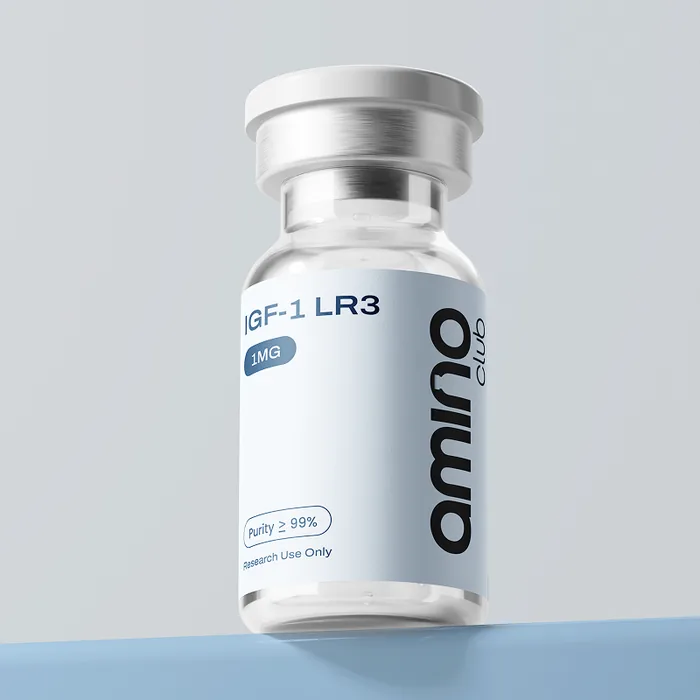
An IGF-1 analogue engineered to escape its binding proteins, which is why its effective half-life is measured in hours rather than minutes.
- Structure
- 83 residues: human IGF-1 with Glu3→Arg and a 13-residue N-terminal extension; three disulfide bridges
- Molecular formula
- C400H619N111O115S9
- Molecular weight
- 9111.5 g/mol
- CAS number
- 946870-92-4
- Appearance
- white lyophilised powder
- Strengths available
- 0.1mg, 1mg per vial
- Purity
- ≥99% by HPLC, identity confirmed by mass spectrometry
- Released against
- the Certificate of Analysis for its own batch
About IGF-1 LR3
Native insulin-like growth factor 1 is 70 residues long. IGF-1 LR3 (Long R3 IGF-1) is 83: the native sequence with arginine substituted for glutamic acid at position 3, plus a 13-residue N-terminal extension derived from porcine growth hormone. It is a small protein with three disulfide bridges.
The arginine substitution is the functional change. In circulation, most IGF-1 is captured by IGF-binding proteins, principally IGFBP-3, and is inactive at any given moment. Arginine at position 3 markedly reduces that capture, so far more of the molecule stays available to the receptor, and the extension adds resistance to clearance. That is the entire design intent, and also why results do not transfer directly from native IGF-1 studies.
What the research covers
Its target is IGF-1R, a receptor tyrosine kinase signalling through PI3K-Akt and the MAPK cascade, pathways concerned with protein synthesis, proliferation and the suppression of apoptosis. Research covers myoblast proliferation and differentiation, and it is widely used as a cell culture supplement because it works in serum-containing media where binding proteins would sequester native IGF-1.
It is also the tool for separating growth hormone from its messenger. Much of what growth hormone does, it does through hepatic IGF-1, so an effect seen after somatropin or a secretagogue could act at either level; supplying IGF-1 directly resolves that. Because of its homology with insulin, insulin receptor cross-reactivity is a real consideration, and designs that ignore it can misattribute a metabolic observation. MGF, an alternative splice product of the same gene, covers a related but local part of the axis. Published work is indexed on PubMed.
Handling IGF-1 LR3
This is the least forgiving item in the group, and its handling does not generalise from the rest of the catalogue. An 83-residue protein with three disulfide bridges loses activity through misfolding and aggregation, neither of which a mass measurement detects. It is supplied at low total mass, which makes adsorption losses proportionally larger.
Reconstitute gently, never shake, avoid freeze-thaw entirely, and prepare working solutions immediately before use. Solvent options are under reconstitution supplies.
Common questions about IGF-1 LR3
What does LR3 stand for?
Long R3: “long” for the 13-residue N-terminal extension, and “R3” for the arginine substituted at position 3.
Why does it last longer than native IGF-1?
The position-3 substitution sharply reduces binding by IGF-binding proteins, which normally hold most IGF-1 inactive, and the extension adds resistance to clearance.
How does it relate to growth hormone research?
Growth hormone acts largely through IGF-1. Supplying IGF-1 LR3 directly lets researchers separate effects at the growth hormone receptor from effects downstream of it.
How does it relate to MGF?
MGF is an alternative splice product of the same IGF-1 gene that acts locally in tissue, whereas IGF-1 LR3 is an analogue of the circulating form.
How should IGF-1 LR3 be stored?
Sealed vials are kept cold. Solutions are prepared immediately before use, never shaken and never frozen and thawed.