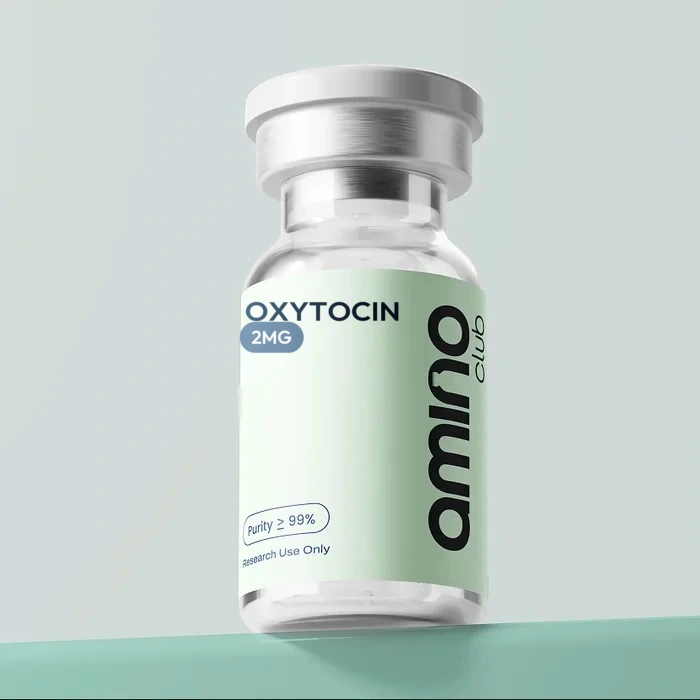
Nine residues closed into a ring by a single disulfide bond. It differs from vasopressin at two positions, which is why nothing about its selectivity can be taken for granted.
- Sequence
- Cys-Tyr-Ile-Gln-Asn-Cys-Pro-Leu-Gly-NH2, Cys1–Cys6 disulfide
- Molecular formula
- C43H66N12O12S2 (free base)
- Molecular weight
- 1007.2 g/mol (free base)
- CAS number
- 50-56-6
- Salt form
- acetate
- Appearance
- white lyophilised powder
- Strengths available
- 2mg, 5mg per vial
- Purity
- ≥99% by HPLC, identity confirmed by mass spectrometry
- Released against
- the Certificate of Analysis for its own batch
About Oxytocin Acetate
The sequence is Cys-Tyr-Ile-Gln-Asn-Cys-Pro-Leu-Gly-NH2, with a disulfide bridge between the two cysteines closing a six-residue ring and leaving a three-residue tail. It was the first peptide hormone to be chemically synthesised, part of why its pharmacology is so thoroughly documented.
Vasopressin has the same architecture and differs at only two positions. Oxytocin acts at its receptor, OXTR, a class-A G-protein-coupled receptor signalling through Gq/11, phospholipase C and calcium release, with Gi coupling reported in some systems. Cross-reactivity at the vasopressin V1a receptor is not negligible and has to be addressed rather than assumed away. It is supplied as the acetate salt, which matters for cell work: residual trifluoroacetate from purification has biological effects of its own at the concentrations it can reach.
What the research covers
In smooth muscle physiology oxytocin is a century-old classical agonist. Isolated uterine strip preparations respond to it reproducibly, and that assay is still how oxytocin receptor antagonists are characterised; the mammary myoepithelial response is the other established peripheral action.
In neuroscience the literature is newer and much less settled. Oxytocin acts centrally as a neuromodulator, with receptor distribution mapped across species and effects reported on social recognition, pair bonding, maternal behaviour and anxiety in animal models. The human literature in this area has a well-documented replication problem, so the peripheral physiology and the social neuroscience are best treated as separate bodies of evidence with very different levels of confidence. Peripherally administered oxytocin also crosses into the brain poorly, which bears on how central effects are interpreted. Published work is indexed on PubMed.
Handling Oxytocin Acetate
Supplied lyophilised in a sealed vial. Oxytocin is one of the less stable small peptides in solution: the disulfide bridge is susceptible to reduction and exchange, and aqueous solutions lose potency measurably over days even when refrigerated.
Store the dry powder at -20°C, prepare solutions in small single-use volumes, keep them cold and dark, and avoid repeated freeze-thaw cycles. Allow the vial to reach room temperature before opening so that moisture does not condense onto the powder. Solvent options are under reconstitution supplies.
Common questions about Oxytocin
How does oxytocin differ from vasopressin?
They share the same ring-and-tail structure and differ at only two residues, so oxytocin can also act at vasopressin receptors, especially V1a.
Why is it supplied as an acetate salt?
Trifluoroacetate left from purification can affect cultured cells. The acetate salt avoids that confound in cell-based work.
What are the two main research fields?
Smooth muscle physiology, where it is a classical contractile agonist, and neuroscience, where it is studied as a central neuromodulator.
How reliable is the social neuroscience literature?
Much less settled than the peripheral physiology. The human literature in particular has well-documented replication problems.
How should oxytocin be stored?
Dry powder at -20°C. Solutions are made in small single-use volumes, kept cold and dark, and not repeatedly frozen.