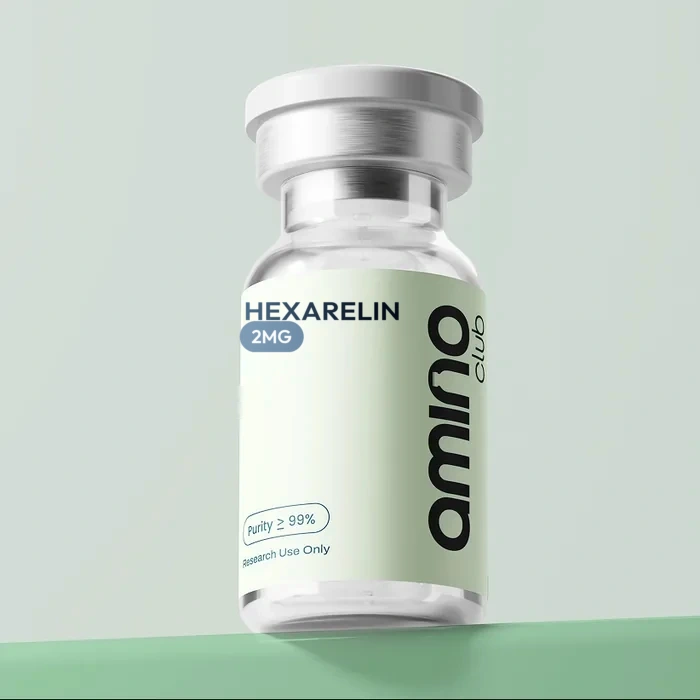
The most potent of the hexapeptide secretagogues, with the fastest desensitisation and a cardiac receptor literature the others do not have.
- Sequence
- His-D-2-Me-Trp-Ala-Trp-D-Phe-Lys-NH2
- Molecular formula
- C47H58N12O6 (free base)
- Molecular weight
- 887.0 g/mol (free base)
- CAS number
- 140703-51-1
- Salt form
- acetate
- Appearance
- white lyophilised powder
- Strengths available
- 2mg, 5mg per vial
- Purity
- ≥99% by HPLC, identity confirmed by mass spectrometry
- Released against
- the Certificate of Analysis for its own batch
About Hexarelin Acetate
Hexarelin is a synthetic hexapeptide, His-D-2-methyl-Trp-Ala-Trp-D-Phe-Lys-NH2. The methyl group on the second tryptophan is the stability feature, and the D-configuration residues and terminal amide do the rest of the work of surviving in solution. At GHSR-1a it is a potent agonist, structurally related to GHRP-2 and comparable to or stronger than it in the growth hormone response it produces, sitting at the far end of the potency-versus-selectivity axis that runs through this class.
It also binds a second, unrelated receptor: CD36, a scavenger receptor expressed on cardiac myocytes, macrophages and endothelium. That interaction has nothing to do with growth hormone, and it gives Hexarelin a cardiovascular literature none of its siblings share.
What the research covers
Growth hormone work treats it as a maximal stimulus, with the known caveats: cortisol, prolactin and ACTH cross-activity, and pronounced receptor desensitisation on repeated exposure. That makes it a poor choice for chronic protocols and a useful one for studying desensitisation itself, which was characterised most thoroughly with this ligand.
The CD36 strand covers infarct and ischaemia-reperfusion models, myocardial protection, cardiac remodelling and angiogenesis, with effects that persist in animals lacking a functional growth hormone axis. That is both an opportunity and a trap: one ligand can interrogate two unrelated pathways, but a cardiac observation is easily misattributed to growth hormone when CD36 is the likelier route. That is why Hexarelin studies so often include a selective secretagogue such as Ipamorelin as a discriminating control. Published work is indexed on PubMed.
Handling Hexarelin Acetate
Supplied lyophilised as the acetate salt. Robust dry, adsorption-prone in dilute solution like the rest of the short secretagogues.
The practical design note is desensitisation rather than storage: a repeated-exposure protocol will show a declining response that is receptor-level, not a degraded preparation, and distinguishing the two requires a fresh-solution control. Store sealed at -20°C. Solvent options are under reconstitution supplies.
Common questions about Hexarelin
What is CD36 and why does it matter?
CD36 is a scavenger receptor found on heart muscle cells, macrophages and endothelium. Hexarelin binds it independently of the growth hormone receptor, which is the basis of its separate cardiac literature.
How does Hexarelin differ from GHRP-2?
Both are potent, non-selective ghrelin receptor agonists. Hexarelin desensitises faster and additionally binds CD36, which GHRP-2 is not known for.
Why does the response fall with repeated exposure?
GHSR-1a desensitises under continued stimulation. A fresh-solution control distinguishes this receptor effect from a degraded preparation.
How are CD36 effects separated from growth hormone effects?
By running a selective secretagogue such as Ipamorelin alongside. An effect present with Hexarelin but absent with Ipamorelin points towards CD36.
How should Hexarelin be stored?
Sealed vials at -20°C. Solutions are prepared fresh at concentrations high enough to limit surface adsorption.