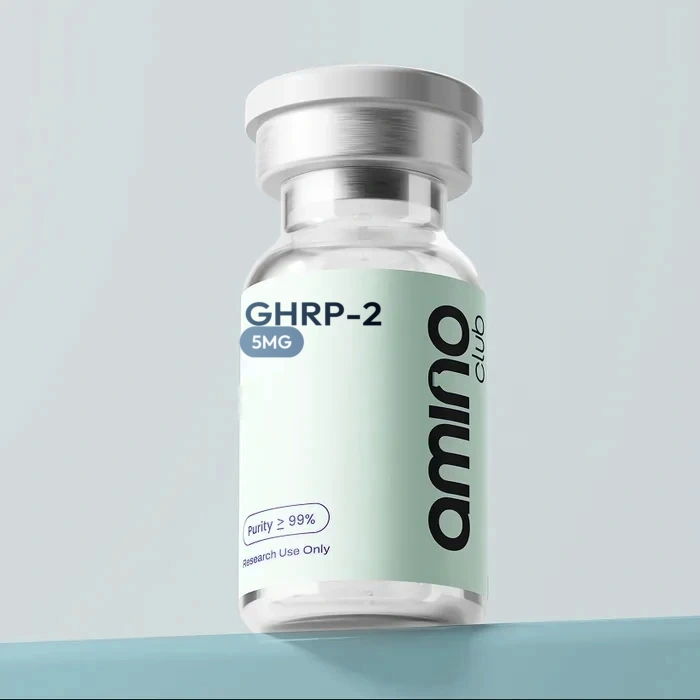
The potent end of the ghrelin receptor agonists: a stronger releaser than Ipamorelin, and correspondingly less selective about what else it releases.
- Sequence
- D-Ala-D-2-Nal-Ala-Trp-D-Phe-Lys-NH2
- Synonym
- pralmorelin
- Molecular formula
- C45H55N9O6 (free base)
- Molecular weight
- 818.0 g/mol (free base)
- CAS number
- 158861-67-7
- Salt form
- acetate
- Appearance
- white lyophilised powder
- Strengths available
- 5mg, 10mg per vial
- Purity
- ≥99% by HPLC, identity confirmed by mass spectrometry
- Released against
- the Certificate of Analysis for its own batch
About GHRP-2 Acetate
GHRP-2, also known as pralmorelin, is a synthetic hexapeptide, D-Ala-D-2-Nal-Ala-Trp-D-Phe-Lys-NH2. It is built around three unnatural features: two D-amino acids, a naphthylalanine side chain and a C-terminal amide. None arise by accident, and all three exist to resist the proteases that would otherwise clear a hexapeptide in moments.
It acts on GHSR-1a, the ghrelin receptor, the same target as Ipamorelin and MK-677, signalling through Gq, phospholipase C and intracellular calcium. It belongs to the releasing peptide series developed before selectivity became the design objective, so it produces a larger growth hormone response than Ipamorelin along with measurable increases in cortisol, prolactin and ACTH. That trade is the single most important fact about the compound when designing around it.
What the research covers
This is the appropriate compound where a saturating stimulus is wanted, such as pituitary responsiveness assays and maximal release protocols, or where the broader ghrelin receptor profile is itself the subject. It is often the positive control rather than the compound under test: a potent secretagogue confirms a preparation can mount a large response before a selective one is asked a subtler question.
Paired against Ipamorelin it makes one of the cleaner natural experiments in this class. Both are ghrelin receptor agonists; one is selective and one is not, so differences in cortisol, prolactin or ACTH between the arms can be attributed to receptor promiscuity rather than a different pathway. Receptor desensitisation is more pronounced with the potent agonists, which matters for repeated-exposure designs. Published work is indexed on PubMed.
Handling GHRP-2 Acetate
Supplied lyophilised as the acetate salt. A hexapeptide of this type is reasonably robust dry and adsorption-prone in dilute solution, so low working concentrations lose material to container surfaces.
Store sealed at -20°C and prepare solutions fresh. Solvent options are under reconstitution supplies.
Common questions about GHRP-2
How does GHRP-2 differ from Ipamorelin?
Both act on the ghrelin receptor. GHRP-2 produces a larger growth hormone response but also raises cortisol, prolactin and ACTH; Ipamorelin is weaker but far more selective.
Why is GHRP-2 often used as a positive control?
Its potency confirms that a pituitary preparation can produce a large response at all, before a more selective compound is tested on a finer question.
Is GHRP-2 the same as pralmorelin?
Yes. Pralmorelin is its international non-proprietary name.
What is receptor desensitisation?
With repeated or continuous exposure, GHSR-1a responds less strongly. It is a property of the receptor, more pronounced with potent agonists, and needs accounting for in repeated-exposure designs.
How should GHRP-2 be stored?
Sealed vials at -20°C. Solutions are prepared fresh and not held at very low concentrations, where adsorption losses dominate.