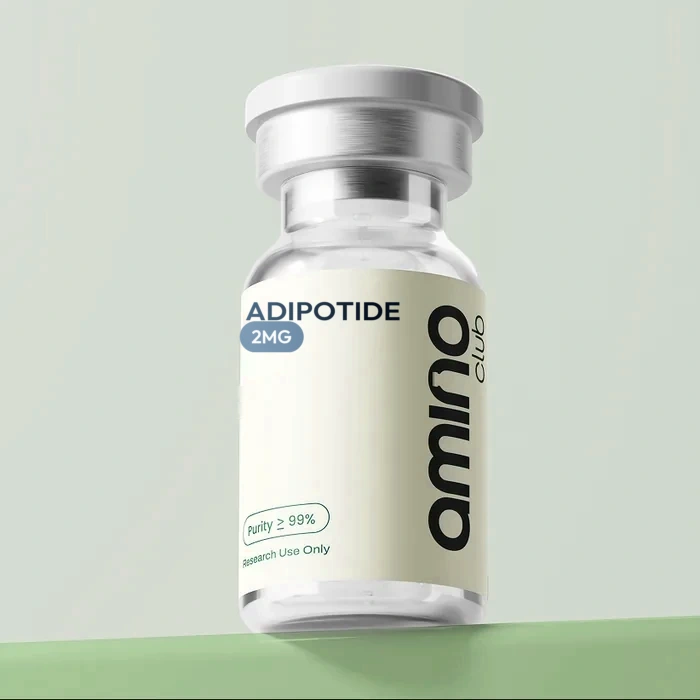
A targeting sequence joined to a cell-killing sequence, studied not for signalling but for removing the blood supply that adipose tissue depends on.
- Structure
- prohibitin-targeting motif CKGGRAKDC linked to the proapoptotic D-amino acid sequence (KLAKLAK)2
- Synonym
- FTPP (fat-targeted proapoptotic peptide)
- Appearance
- white lyophilised powder
- Strengths available
- 2mg, 5mg per vial
- Purity
- ≥99% by HPLC, identity confirmed by mass spectrometry
- Released against
- the Certificate of Analysis for its own batch
About Adipotide
Adipotide, also known as FTPP (fat-targeted proapoptotic peptide), has two halves that do different jobs. The first is a short cyclic motif that binds prohibitin, a protein found at unusually high levels on the endothelial cells lining the blood vessels of white adipose tissue. The second is the proapoptotic sequence D(KLAKLAK)2, built from D-amino acids, which disrupts mitochondrial membranes once internalised.
Linked together, the construct is an addressing system: the first half finds the cell type and the second half kills it. The intended consequence is loss of the capillary network supplying fat tissue and regression of the tissue through lack of perfusion. That is fundamentally different from everything else in the metabolic group: the incretin and amylin analogues change signalling and AOD-9604 changes lipid handling, while adipotide destroys vasculature.
What the research covers
Work covers prohibitin expression on adipose endothelium, selectivity of the targeting motif, apoptosis in endothelial models, and the downstream effect on adipose mass. Rodent and non-human primate studies reported substantial reductions in fat mass, and constructs lacking the prohibitin motif did not produce the same effect, supporting the targeting mechanism.
The record’s stopping point matters as much. Renal toxicity appeared in the primate work, unsurprising given that prohibitin is not exclusive to adipose endothelium and a proapoptotic payload has no built-in margin for error. Development did not reach clinical use, and there is no human efficacy or safety literature. Selectivity is the whole question, so studies that do not characterise off-target binding are not assessing what matters; the honest framing is a proof of concept for vascular targeting. Published work is indexed on PubMed.
Handling Adipotide
Supplied lyophilised. This is a cytotoxic construct by design, and should be handled with the containment appropriate to one, a point that does not arise for the signalling peptides in the same group.
Standard reconstitution care applies, with the addition that waste and surplus solution should be disposed of as cytotoxic material rather than as ordinary peptide waste. Store sealed vials at -20°C. Solvent options are under reconstitution supplies.
Common questions about Adipotide
How is Adipotide designed to work?
One half binds prohibitin on the blood vessels of fat tissue; the other half triggers cell death once inside. Together they target and destroy that vasculature.
How does it differ from other metabolic compounds?
It does not modulate signalling or metabolism. It is a cytotoxic targeting construct aimed at the blood supply of adipose tissue.
What limited its development?
Kidney toxicity in primate studies. Prohibitin is not exclusive to fat-tissue vessels, so the payload can act elsewhere.
Has it been tested in humans?
No. Its evidence base is preclinical, in rodents and non-human primates.
How should Adipotide be handled?
As a cytotoxic material: with appropriate containment, and with surplus solution and waste disposed of as cytotoxic. Store sealed at -20°C.