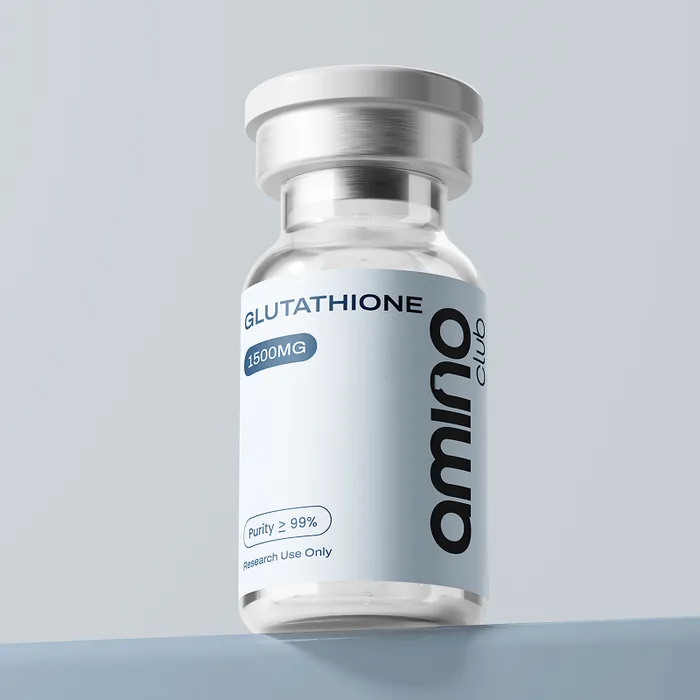
The cell’s principal thiol antioxidant, and the compound in this catalogue whose assay result depends most on how recently the vial was opened.
- Compound
- reduced glutathione (GSH), γ-Glu-Cys-Gly
- Molecular formula
- C10H17N3O6S
- Molecular weight
- 307.3 g/mol
- CAS number
- 70-18-8
- Appearance
- white lyophilised powder
- Strengths available
- 600mg, 1500mg per vial
- Purity
- ≥99% by HPLC, identity confirmed by mass spectrometry
- Released against
- the Certificate of Analysis for its own batch
About Glutathione
Glutathione is gamma-glutamyl-cysteinyl-glycine, present in nearly every cell at millimolar concentration. The gamma linkage matters: the bond between glutamate and cysteine uses the glutamate side-chain carboxyl rather than its backbone one, so ordinary peptidases cannot cleave it. Only gamma-glutamyl transpeptidase can, on the outer face of cell membranes, which is how cells control glutathione turnover.
Its chemistry is the cysteine thiol. Reduced glutathione (GSH) donates an electron and dimerises to the oxidised disulfide GSSG, and the ratio between the two, not the total amount, reports on a cell’s redox state. It is typically held above thirty to one in a healthy cell and used as the standard index of oxidative stress when it falls. It is supplied here in the reduced form.
What the research covers
Work covers the GSH to GSSG ratio as an oxidative stress readout, glutathione peroxidase and reductase activity, phase II detoxification through glutathione S-transferases, protein glutathionylation as a reversible signalling modification, and depletion models using buthionine sulfoximine to block synthesis.
It appears in skin research because it inhibits tyrosinase and shifts melanin synthesis towards lighter pheomelanin, a real effect documented in culture. The difficulty is delivery: oral glutathione is largely hydrolysed before absorption, and reaching melanocytes in the basal epidermis is harder still, so the mechanism is established while delivery is not. A persistent methodological problem is that GSH oxidises in air during sample preparation, so a poor redox ratio can be a handling artefact rather than a property of the sample. Published work is indexed on PubMed.
Handling Glutathione
This is the least stable item in the catalogue once in solution, and the reason is chemical rather than biological: the free thiol oxidises readily in air, faster at neutral or alkaline pH and in the presence of trace metal ions.
Prepare solutions immediately before use and never store them, use degassed buffer where the protocol allows, and consider a chelator to suppress metal-catalysed oxidation. A solution that has stood for an hour is a different preparation from the one you made. Solvent options are under reconstitution supplies.
Common questions about Glutathione
What is the difference between GSH and GSSG?
GSH is reduced glutathione, with a free thiol. GSSG is the oxidised form, two molecules joined by a disulfide bond. Their ratio reflects a cell’s redox state.
Why is glutathione resistant to normal peptidases?
Its glutamate is linked through the side-chain (gamma) carboxyl, a bond ordinary peptidases cannot cleave.
Why does glutathione appear in skin research?
It inhibits tyrosinase and shifts melanin synthesis towards lighter pheomelanin in cultured cells. Delivering it to melanocytes in living skin is the unresolved problem.
Why can measured redox ratios be misleading?
GSH oxidises in air during sample preparation, so careless handling can lower the measured GSH to GSSG ratio independently of the sample’s actual state.
How should glutathione be handled?
Keep the powder sealed and dry. Make solutions immediately before use in degassed buffer and never store them.