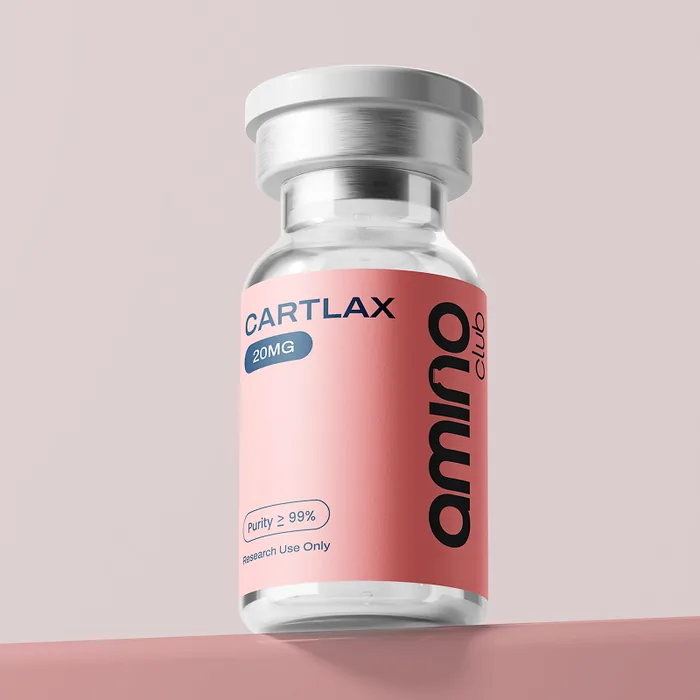
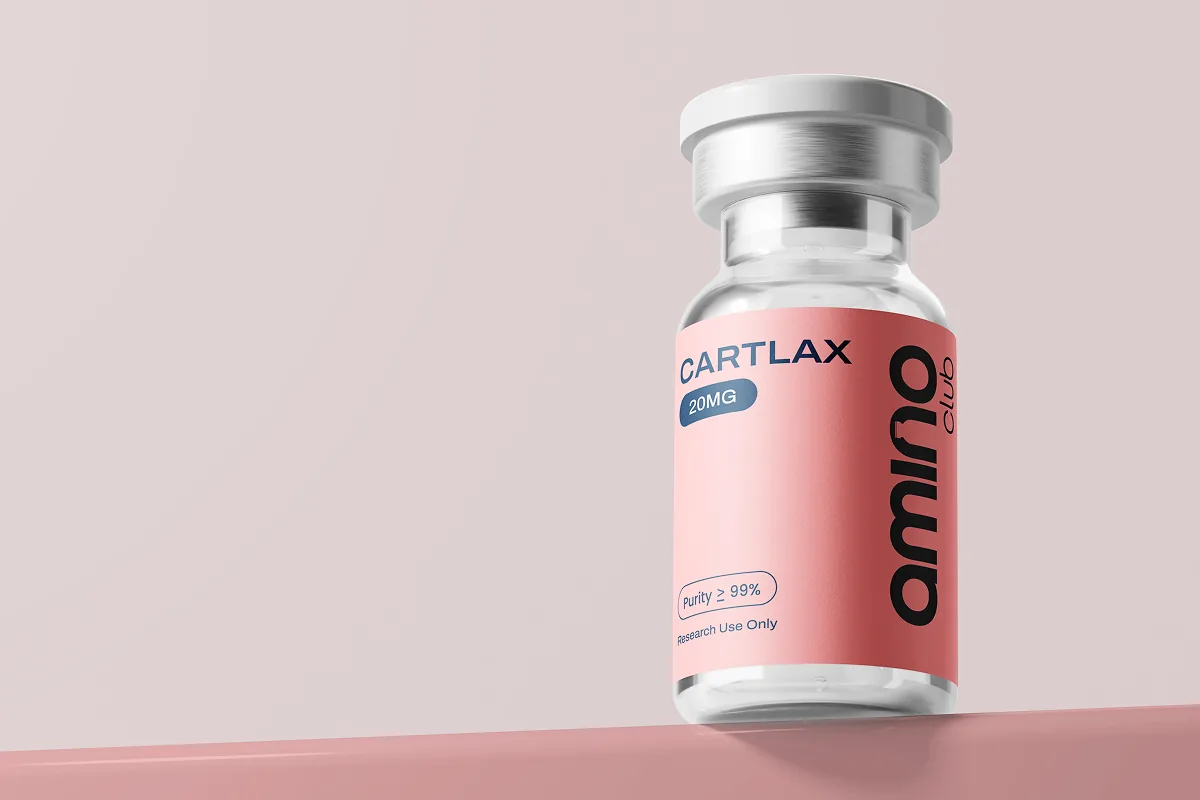
A preparation directed at cartilage matrix work — the tissue where repair research runs into the hardest biological limit.
- Use
- cartilage matrix and chondrocyte research
- Strength
- 20mg per vial
- Appearance
- white lyophilised powder
- Purity
- ≥99% by HPLC, identity confirmed by mass spectrometry
- Released against
- the Certificate of Analysis for its own batch
About Cartlax
Cartlax is supplied for research into cartilage matrix and chondrocyte behaviour. Cartilage is the context that makes this a distinct problem rather than a variation on soft-tissue repair: it is avascular and aneural, chondrocytes are sparse and embedded in dense matrix, and turnover is slow.
That changes what an intervention can be expected to do. Mechanisms that depend on vascular response or on cell recruitment — the basis of most of the rest of this group — have little purchase in a tissue with no blood supply.
What the research covers
Relevant endpoints are matrix composition rather than perfusion: type II collagen and aggrecan synthesis, proteoglycan content, matrix metalloproteinase and aggrecanase activity, and chondrocyte phenotype stability — the tendency of chondrocytes to dedifferentiate in culture is itself a major methodological obstacle.
Because cartilage models are slow, study duration is longer here than elsewhere in the catalogue, and short-exposure designs tend to produce null results that say more about the design than the compound. The tissue repair research peptides hub sets out the mechanisms in this group.
Handling Cartlax
Supplied lyophilised. Standard peptide handling applies — gentle reconstitution, cold storage, solutions prepared fresh.
The distinctive consideration is experimental rather than chemical: cartilage work typically uses explant or three-dimensional culture over weeks, which means repeated media changes and a preparation that must be remade consistently each time rather than once.
Solvent options are under reconstitution supplies.
Common questions about Cartlax
Why is cartilage a distinct research problem?
Cartilage has no blood supply or nerves, sparse cells and slow turnover, so mechanisms that rely on vascular response or cell recruitment have little effect there.
Which endpoints matter in cartilage work?
Matrix composition: type II collagen and aggrecan synthesis, proteoglycan content, and matrix-degrading enzyme activity, along with chondrocyte phenotype.
Why do cartilage studies take longer?
Matrix turns over slowly, so short exposures tend to give null results that reflect the design rather than the compound.
How should it be handled?
Standard peptide practice: gentle reconstitution, cold storage and fresh solutions, remade consistently across the repeated media changes of long cultures.