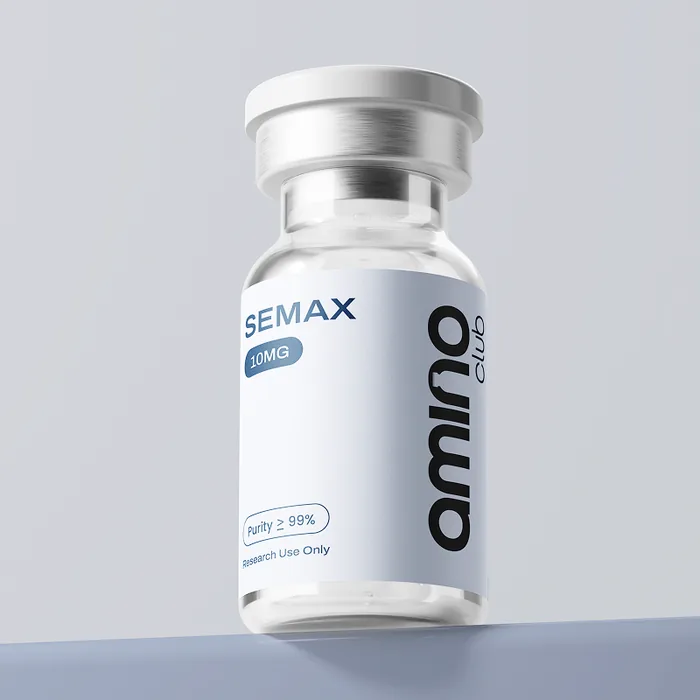
An ACTH fragment analogue with the hormonal activity stripped out. What remains is studied for BDNF expression and monoamine signalling.
- Sequence
- Met-Glu-His-Phe-Pro-Gly-Pro (ACTH 4–7 + Pro-Gly-Pro)
- Molecular formula
- C37H51N9O10S
- Molecular weight
- 813.9 g/mol
- CAS number
- 80714-61-0
- Appearance
- white lyophilised powder
- Strengths available
- 5mg, 10mg per vial
- Purity
- ≥99% by HPLC, identity confirmed by mass spectrometry
- Released against
- the Certificate of Analysis for its own batch
About Semax
Adrenocorticotropic hormone is 39 residues long, and its hormonal function, driving cortisol release from the adrenal cortex through the melanocortin-2 receptor, depends on a region Semax does not contain. Semax is ACTH(4-7), Met-Glu-His-Phe, extended by the C-terminal tripeptide Pro-Gly-Pro, giving the heptapeptide Met-Glu-His-Phe-Pro-Gly-Pro.
Removing the hormonal region while keeping the behaviourally active fragment is the design. The result has no corticotropic activity, so an effect observed with Semax cannot be attributed to a cortisol response, a confound that complicates work with the parent hormone. The Pro-Gly-Pro tail is a protease-resistance motif found in endogenous regulatory peptides, and it extends the usable life of a fragment that would otherwise be cleaved within moments.
What the research covers
The best-developed strand concerns brain-derived neurotrophic factor: published work reports that Semax increases BDNF and its receptor TrkB in hippocampal tissue, a plausible route from a seven-residue peptide to learning and memory effects in animal models without a direct neurotransmitter action. NGF expression has also been reported.
Further strands cover the noradrenergic and dopaminergic systems with attention and memory endpoints, and neuroprotection in ischaemia models, where most of the clinical work in its country of origin sits; it has been in clinical use there. Much of the primary literature was published in Russian-language journals, and methodological detail is not always recoverable from the translations in circulation, which is worth knowing when an English-language search looks thinner than the actual evidence base. It is routinely studied alongside Selank, which acts on an unrelated system. Published work is indexed on PubMed.
Handling Semax
Supplied lyophilised. The Pro-Gly-Pro tail gives real protection against proteolysis, which matters in preparations containing peptidases, but it does nothing for adsorption: a seven-residue peptide still loses material to container surfaces at low concentration.
Use low-binding plasticware, reconstitute gently and prepare working solutions fresh. The methionine residue is oxidation-prone, so limit air exposure. Store sealed vials at -20°C. Solvent options are under reconstitution supplies.
Other formats
Semax is also supplied as a metered 25ml Semax nasal spray, where no reconstitution step is needed.
Common questions about Semax
Does Semax act like ACTH?
No. It contains only the ACTH(4-7) fragment plus a stabilising tail and lacks the region responsible for cortisol release, so it has no corticotropic activity.
What does the Pro-Gly-Pro tail do?
It is a protease-resistance motif that protects the short fragment from rapid enzymatic cleavage.
What is Semax mainly studied for?
Increases in BDNF and its receptor TrkB in the hippocampus, along with monoamine signalling and neuroprotection in ischaemia models.
How does Semax differ from Selank?
Both share the Pro-Gly-Pro tail, but Semax derives from a pituitary hormone fragment and Selank from the immune peptide tuftsin. They act on unrelated systems.
How should Semax be stored?
Sealed vials at -20°C. Solutions are prepared fresh in low-binding plasticware.