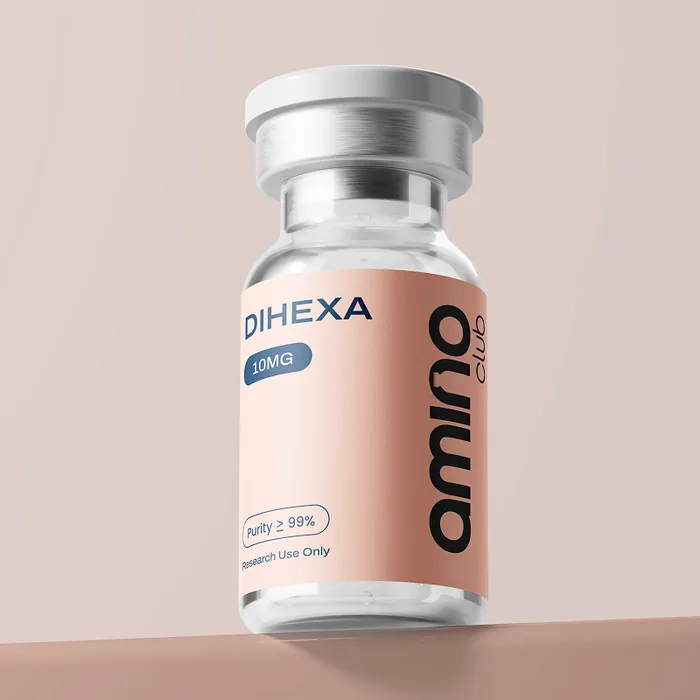
An angiotensin IV derivative that acts nothing like an angiotensin, studied instead for amplifying hepatocyte growth factor signalling at the synapse.
- Structure
- N-hexanoyl-Tyr-Ile-(6)-aminohexanoic amide
- Molecular formula
- C27H44N4O5
- Molecular weight
- 504.7 g/mol
- CAS number
- 1401708-83-5
- Appearance
- white lyophilised powder
- Strength
- 10mg per vial
- Purity
- ≥99% by HPLC, identity confirmed by mass spectrometry
- Released against
- the Certificate of Analysis for its own batch
About Dihexa
Dihexa is N-hexanoyl-Tyr-Ile-(6)-aminohexanoic amide: a tyrosine-isoleucine dipeptide carrying a hexanoyl chain at one end and an aminohexanoic amide at the other. It derives from angiotensin IV, a fragment of the renin-angiotensin system with a cognitive literature quite separate from that system’s blood-pressure role.
The two lipophilic groups do the delivery work. An unmodified dipeptide would be cleaved in minutes and would not cross the blood-brain barrier; the additions confer metabolic stability and lipophilicity, and published work reports oral activity in animals as a result. That makes it structurally unlike the rest of this group, which acts through neuropeptide routes.
What the research covers
The proposed mechanism is potentiation of hepatocyte growth factor signalling at its receptor c-Met, amplifying a signal HGF is already producing rather than acting as a direct agonist. HGF-c-Met signalling is implicated in dendritic spine formation, the basis of the synaptogenesis hypothesis. Work covers c-Met signalling, dendritic spine density and synaptogenesis in hippocampal preparations, and cognitive endpoints in rodent models of impairment, where reported potency is striking relative to the parent fragment.
Dihexa attracts strong claims that the evidence does not support. Everything published is preclinical: there is no human trial literature and no established safety characterisation. c-Met is a proto-oncogene, so amplifying its signalling is a mechanism where the absence of long-term data is a substantive gap, and extended designs warrant proliferative controls. Published work is indexed on PubMed.
Handling Dihexa
Supplied lyophilised. Being lipophilic rather than a conventional hydrophilic peptide, its solubility behaviour differs from the rest of the catalogue: aqueous buffer alone may be insufficient, and a co-solvent is often required.
Establish solubility before a protocol depends on it, and check that any co-solvent used is tolerated by the assay system at the concentration needed. Store sealed vials at -20°C. Solvent options are under reconstitution supplies.
Common questions about Dihexa
What is Dihexa derived from?
Angiotensin IV, a fragment of the renin-angiotensin system, heavily modified for stability and lipophilicity.
How is Dihexa proposed to work?
By potentiating hepatocyte growth factor signalling at its receptor c-Met, a pathway implicated in forming new synaptic connections.
How strong is the evidence for Dihexa?
It is entirely preclinical. There are no human trials and no established safety characterisation.
Why are proliferative controls recommended?
c-Met is a proto-oncogene, so a compound amplifying its signalling warrants checks for unwanted proliferation in extended experiments.
How should Dihexa be dissolved and stored?
Sealed vials at -20°C. Because it is lipophilic, a co-solvent may be needed, and solubility should be confirmed before relying on a protocol.