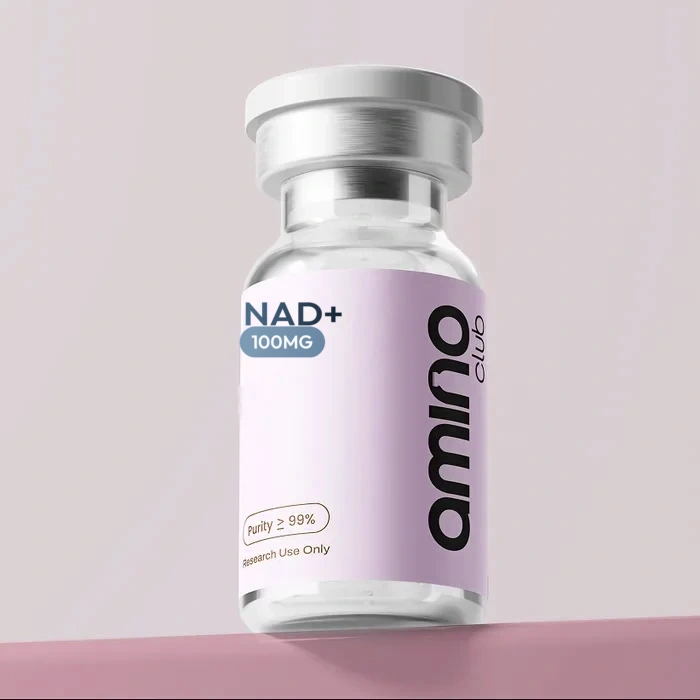
A redox cofactor, not a signalling peptide, and the item in this catalogue whose working solution degrades fastest.
- Compound
- nicotinamide adenine dinucleotide, oxidised form
- Molecular formula
- C21H27N7O14P2
- Molecular weight
- 663.4 g/mol
- CAS number
- 53-84-9
- Appearance
- white to off-white lyophilised powder
- Strengths available
- 100mg, 500mg, 1000mg per vial
- Purity
- ≥99% by HPLC, identity confirmed by mass spectrometry
- Released against
- the Certificate of Analysis for its own batch
About NAD+
Nicotinamide adenine dinucleotide is a dinucleotide cofactor present in every living cell, not a peptide and not a signalling molecule in the way the rest of this catalogue is. It cycles between oxidised NAD+ and reduced NADH, carrying electrons through the reactions of central metabolism.
Its research interest rests on a second role. NAD+ is consumed rather than cycled by three enzyme families: the sirtuins, which deacetylate histones and metabolic regulators; the PARPs, which act in the DNA damage response; and CD38. Because these enzymes use the molecule up, cellular availability becomes a constraint on their activity, and the decline in NAD+ concentration observed with age is the premise the whole field rests on.
What the research covers
The largest strand covers sirtuin-dependent signalling: mitochondrial biogenesis, metabolic regulation and the transcriptional consequences of altered deacetylase activity. A second covers PARP-mediated DNA repair and the competition between PARPs and sirtuins for a shared and limited pool. A third addresses raising intracellular concentration, which is where most of the methodological difficulty sits.
That last point carries a warning. NAD+ does not cross the plasma membrane efficiently, so much published work uses precursors such as nicotinamide riboside and nicotinamide mononucleotide instead. Applying the cofactor and applying a precursor are not the same experiment, and secondary sources routinely blur the two. Published work is indexed on PubMed.
Handling NAD+
Hygroscopic in the dry state and genuinely unstable in solution: hydrolysis to nicotinamide and ADP-ribose proceeds at a rate that depends sharply on pH and temperature, and it is fast enough to matter within a working day.
Prepare solutions immediately before use, keep them cold and slightly acidic where the protocol allows, and do not hold a working solution overnight, because it will no longer be the concentration you prepared. Solvent options are under reconstitution supplies.
Other formats
NAD+ is also supplied as a metered intranasal preparation, NAD+ nasal spray, where no reconstitution step is needed.
Common questions about NAD+
Is NAD+ a peptide?
No. NAD+ is a dinucleotide cofactor made of two nucleotides joined by their phosphate groups. It is grouped with the longevity peptides because of the research questions it serves, not its chemistry.
What is the difference between NAD+ and NADH?
They are the oxidised and reduced forms of the same cofactor. NAD+ accepts electrons and becomes NADH. The sirtuins, PARPs and CD38 consume the oxidised form, NAD+, which is the form supplied here.
Why do many studies use precursors instead of NAD+?
NAD+ crosses the plasma membrane poorly, so researchers often apply precursors such as nicotinamide riboside or nicotinamide mononucleotide, which cells convert internally. The two approaches test different things, which matters when comparing results.
Why does an NAD+ solution degrade so quickly?
In water, NAD+ hydrolyses to nicotinamide and ADP-ribose, faster at higher temperature and away from slightly acidic pH. Within a working day the loss can be significant, so solutions are prepared immediately before use.
What is the difference between the vial and the nasal spray?
The vial holds dry powder, which is the stable form and is reconstituted immediately before use. The spray is supplied ready-prepared in metered form for designs where the intranasal route is itself under study.