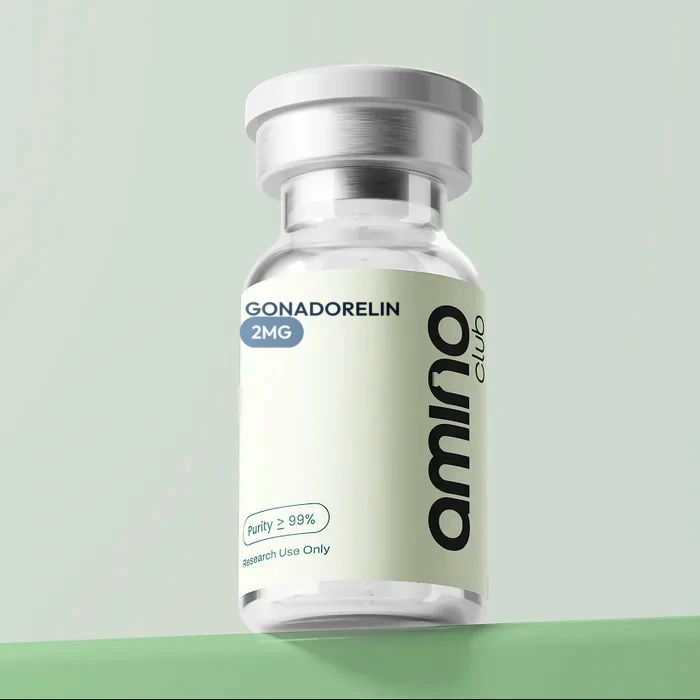
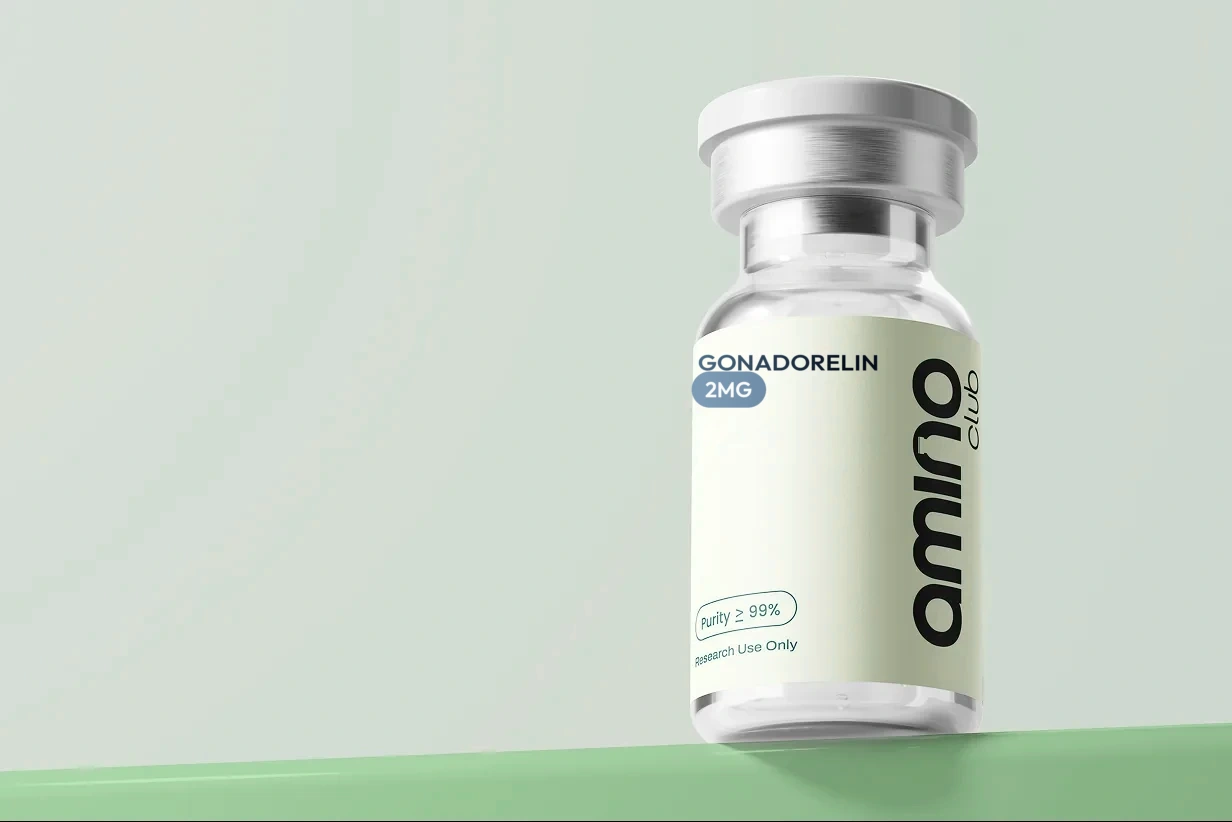
Synthetic GnRH, identical to the hypothalamic decapeptide. The same molecule produces opposite outcomes depending on whether it arrives in pulses or continuously.
- Sequence
- pGlu-His-Trp-Ser-Tyr-Gly-Leu-Arg-Pro-Gly-NH2 (native GnRH)
- Molecular formula
- C55H75N17O13 (free base)
- Molecular weight
- 1182.3 g/mol (free base)
- CAS number
- 33515-09-2
- Appearance
- white lyophilised powder
- Strengths available
- 2mg, 10mg per vial
- Purity
- ≥99% by HPLC, identity confirmed by mass spectrometry
- Released against
- the Certificate of Analysis for its own batch
About Gonadorelin
Gonadorelin is pGlu-His-Trp-Ser-Tyr-Gly-Leu-Arg-Pro-Gly-NH2, the ten-residue hormone released by the hypothalamus to drive the pituitary. It is not an analogue: the sequence is the native one, with the pyroglutamate at one end and the glycinamide at the other, as in the natural molecule.
It acts on the GnRH receptor, a class-A G-protein-coupled receptor on pituitary gonadotrope cells, signalling through Gq/11, phospholipase C and intracellular calcium, and the output is luteinising hormone and follicle-stimulating hormone. Native gonadorelin is cleared within minutes, which is both its characteristic limitation and why it remains the reference compound: analogue series exist because this molecule does not persist, and any claim about what a substitution achieves is measured against it.
What the research covers
Delivered in pulses, gonadorelin drives gonadotropin release. Delivered continuously, it desensitises and downregulates its own receptor, and output falls below baseline. The same agonist at the same receptor changes direction with the temporal pattern of exposure, which makes it the tool for studying how a receptor system encodes frequency rather than amplitude; an experiment on pulse frequency needs a ligand that clears between pulses, which a long-acting analogue cannot provide.
In vitro work clusters around pituitary cell culture: receptor binding and internalisation, calcium and inositol-phosphate readouts, and LH and FSH secretion against pulse frequency and amplitude. It is also the comparator for characterising substituted analogues and a reference ligand in receptor expression studies. The catalogue covers the axis at every level, with kisspeptin above it and HCG and HMG below. Published work is indexed on PubMed.
Handling Gonadorelin
Supplied lyophilised in a sealed vial. The powder is stable at ambient temperature for the short periods involved in transit, and is stored at -20°C, sealed and protected from light, for long-term holding.
In solution the decapeptide is considerably less stable than as a dry powder, so solutions are prepared in small volumes, kept cold and dark, and not held indefinitely. Avoid repeated freeze-thaw cycles. Solvent options are under reconstitution supplies.
Common questions about Gonadorelin
Is gonadorelin an analogue of GnRH?
No. It is the native GnRH decapeptide sequence, made synthetically.
Why does pulsatile versus continuous exposure matter?
Pulses drive LH and FSH release; continuous exposure desensitises the receptor so output falls. The pattern determines the direction of the effect.
Why is it the reference compound for GnRH analogues?
Its short half-life and native sequence make it the baseline against which the effect of each analogue modification is measured.
Where does it sit in the reproductive axis?
At the hypothalamic-pituitary level, below kisspeptin and above the gonadotropins HCG and HMG.
How should gonadorelin be stored?
Sealed at -20°C, protected from light. Solutions are made in small volumes, kept cold and not repeatedly frozen.