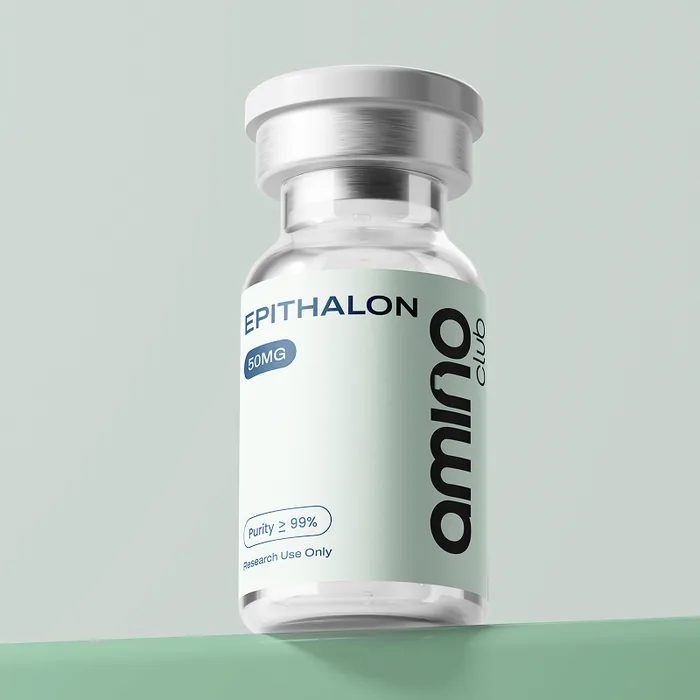
Four amino acids, Ala-Glu-Asp-Gly, carrying one of the stronger claims in this catalogue and one of the thinner replication records.
- Sequence
- Ala-Glu-Asp-Gly (AEDG)
- Synonym
- epitalon
- Molecular formula
- C14H22N4O9
- Molecular weight
- 390.3 g/mol
- CAS number
- 307297-39-8
- Appearance
- white lyophilised powder
- Strengths available
- 10mg, 50mg per vial
- Purity
- ≥99% by HPLC, identity confirmed by mass spectrometry
- Released against
- the Certificate of Analysis for its own batch
About Epithalon
Epithalon, also written epitalon, is the synthetic tetrapeptide Ala-Glu-Asp-Gly, one of the shortest sequences in the catalogue. It was derived from Epithalamin, a peptide preparation extracted from bovine pineal gland, by identifying the minimal active fragment, the same logic that produced BPC-157 from a larger parent protein.
It comes from the St Petersburg bioregulator programme, which ran from the 1970s and also produced Pinealon and Thymalin. That provenance matters for reading the literature. Much of the primary literature was published in Russian-language journals, and methodological detail is not always recoverable from the translations in circulation, which is worth knowing when an English-language search looks thinner than the actual evidence base.
What the research covers
The most cited strand reports induction of telomerase activity and telomere extension in somatic cell culture, with a proposed mechanism involving direct interaction with promoter regions of the telomerase gene. This is the claim that carries the compound’s reputation, and a four-residue peptide interacting selectively with a gene promoter is a strong claim on its face, most in need of independent replication outside the original group.
A second strand concerns pineal function and circadian regulation, reflecting its origin: melatonin and cortisol rhythm and their age-related changes. A third covers antioxidant and immune endpoints in ageing models. The honest assessment is that the mechanistic story is interesting and the replication record is thin, so existing findings are best treated as hypotheses to test rather than as settled. Published work is indexed on PubMed.
Handling Epithalon
Supplied lyophilised. Very short peptides are simple to synthesise, which means high purity is readily achievable and a poor preparation is equally easy to pass off: identity confirmation, rather than the purity figure, is what establishes the material is what the label says.
Adsorption at low working concentration is the practical loss. Use low-binding plasticware and prepare solutions fresh. Store sealed vials at -20°C. Solvent options are under reconstitution supplies.
Common questions about Epithalon
Where does Epithalon come from?
It is the minimal active fragment identified from Epithalamin, a peptide extract of bovine pineal gland, developed in the St Petersburg bioregulator programme.
Is Epithalon the same as epitalon?
Yes. Both spellings refer to the same tetrapeptide, Ala-Glu-Asp-Gly.
What is the telomerase claim?
Reports describe Epithalon inducing telomerase activity and extending telomeres in cell culture. It is the compound’s best-known claim and the one most in need of independent replication.
Why is identity confirmation important for such a short peptide?
Short sequences are easy to synthesise to a high purity figure, so mass spectrometry, not the purity number, is what confirms the vial holds the correct sequence.
How should Epithalon be stored?
Sealed vials at -20°C. Solutions are prepared fresh in low-binding plasticware.