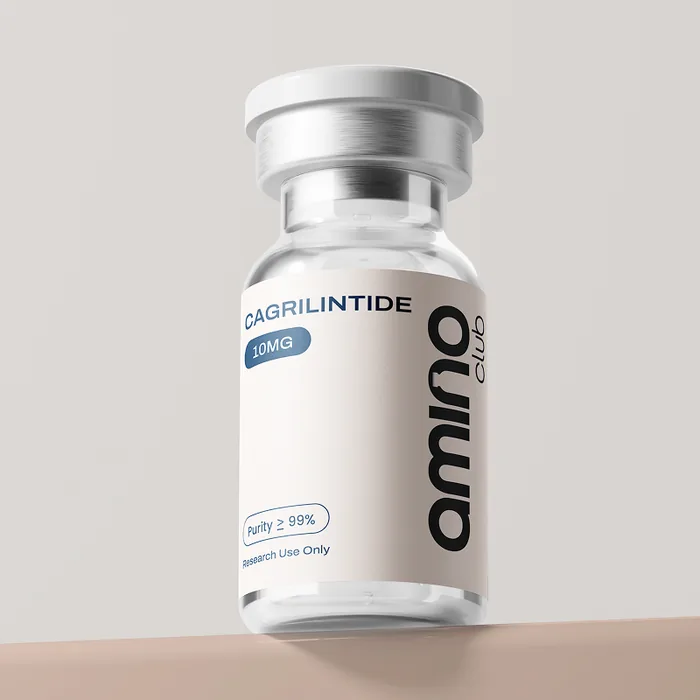
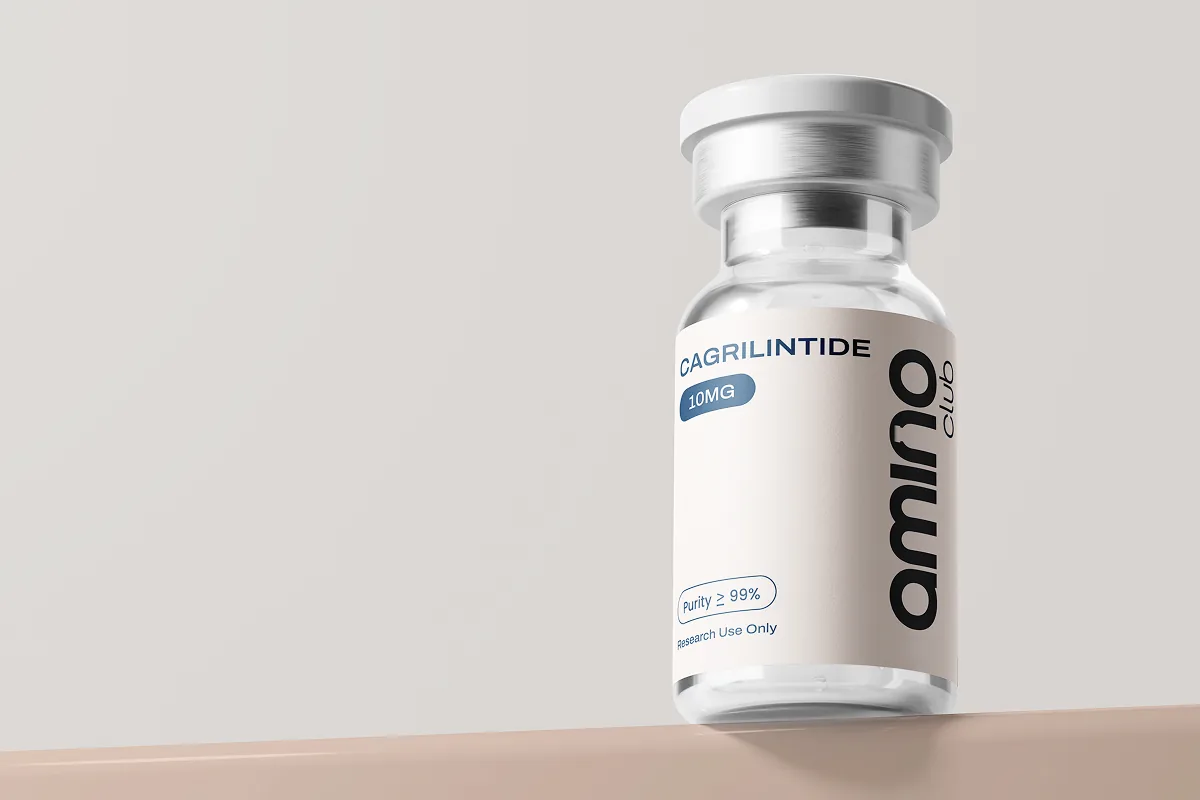
A long-acting amylin analogue: satiety signalling through a receptor family entirely separate from the incretins, which is why it is studied alongside them rather than instead of them.
- Structure
- acylated 37-residue amylin analogue, Cys3–Cys8 disulfide bridge, C-terminal amide
- Molecular formula
- C194H312N54O59S2
- Molecular weight
- 4409.0 g/mol
- CAS number
- 1415456-99-3
- Appearance
- white to off-white lyophilised powder
- Strengths available
- 5mg, 10mg per vial
- Purity
- ≥99% by HPLC, identity confirmed by mass spectrometry
- Released against
- the Certificate of Analysis for its own batch
About Cagrilintide
Amylin is a 37-residue peptide co-secreted with insulin from pancreatic beta-cells. It signals satiety, slows gastric emptying and suppresses glucagon, acting through calcitonin receptors complexed with receptor activity-modifying proteins to form the AMY1, AMY2 and AMY3 receptor subtypes. That is a different receptor family from the incretins.
Native human amylin has a serious practical problem: it aggregates into amyloid fibrils, which is both a formulation obstacle and a feature of the pathology in type 2 diabetes. Cagrilintide is an engineered analogue with substitutions that suppress that aggregation, plus an eicosanedioic acid chain attached through a gamma-glutamate linker that binds albumin and extends its circulating life from minutes to days.
What the research covers
Work covers receptor pharmacology at the calcitonin and amylin receptor complexes, hindbrain and hypothalamic satiety circuits, gastric emptying, and the aggregation behaviour of engineered analogues. The most active area is the interaction with GLP-1 receptor signalling: GLP-1 agonists and amylin analogues both reduce food intake, but through different receptors in different hindbrain nuclei.
Two independent pathways invite the obvious experiment: amylin analogue alone, incretin agonist alone, and both together, with the question being whether the effects are additive. Additivity would imply the pathways converge downstream rather than duplicating each other. Answering that requires the single agents, because a combined preparation cannot attribute an effect to either component. Published work is indexed on PubMed.
Handling Cagrilintide
Supplied lyophilised. Aggregation is the defining handling concern for any amylin analogue, more so than for the incretins: the parent peptide forms fibrils, and while the analogue is engineered against it, agitation and concentration still push in that direction. As an acylated peptide of this length it is also surface active, and its self-association depends on concentration.
Reconstitute gently, keep concentrations within what the protocol requires rather than higher, and do not re-freeze a reconstituted vial. The sealed powder is stored at -20°C. Solvents are under reconstitution supplies.
Other formats
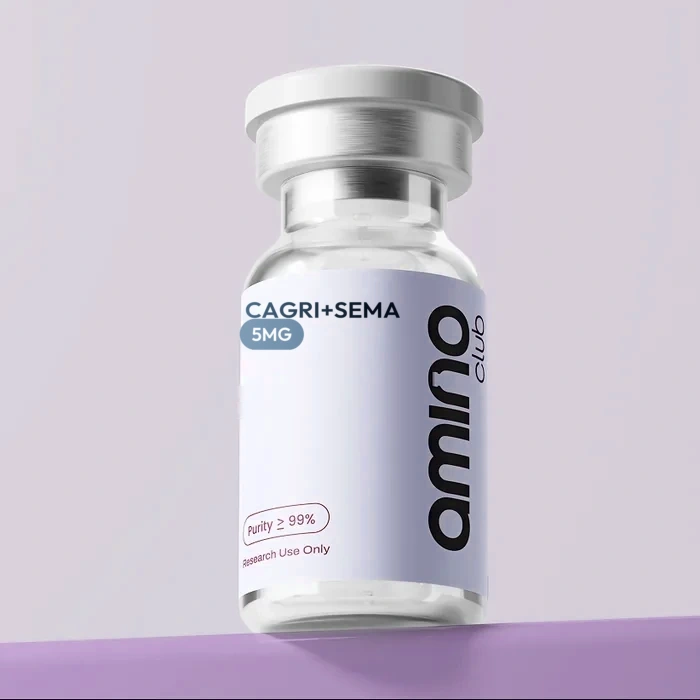
Cagrilintide is also supplied in a combined preparation, Cagrilintide + Semaglutide, for dual-pathway work. Because a combined preparation cannot separate the contribution of each component, attribution studies use the single agent alongside it.
Common questions about Cagrilintide
Is Cagrilintide a GLP-1 agonist?
No. It is an amylin analogue acting at calcitonin and amylin receptors. It affects appetite regulation through a different receptor family from the GLP-1 system, which is why the two are studied together.
Why does native amylin need to be modified?
Human amylin aggregates readily into amyloid fibrils, which makes it impractical to formulate. Cagrilintide carries substitutions that suppress aggregation and a fatty-acid chain that extends its half-life through albumin binding.
Why is it studied in combination with GLP-1 agonists?
Because the two act through independent pathways, combining them tests whether their effects add together. That question is mechanistically informative, since additivity implies the pathways converge downstream.
When is the single agent needed rather than the combination?
Whenever an effect has to be attributed to the amylin arm specifically. A combined preparation shows what the pair does together; only the single agents show which component is responsible.
How should Cagrilintide be stored?
Sealed powder is held at -20°C. Solutions are prepared gently without vigorous agitation, kept cold, used promptly and not re-frozen.