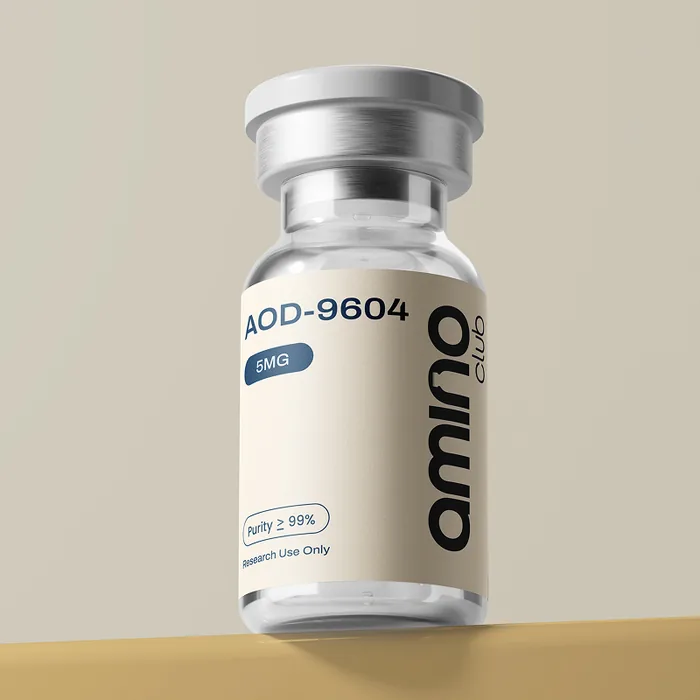
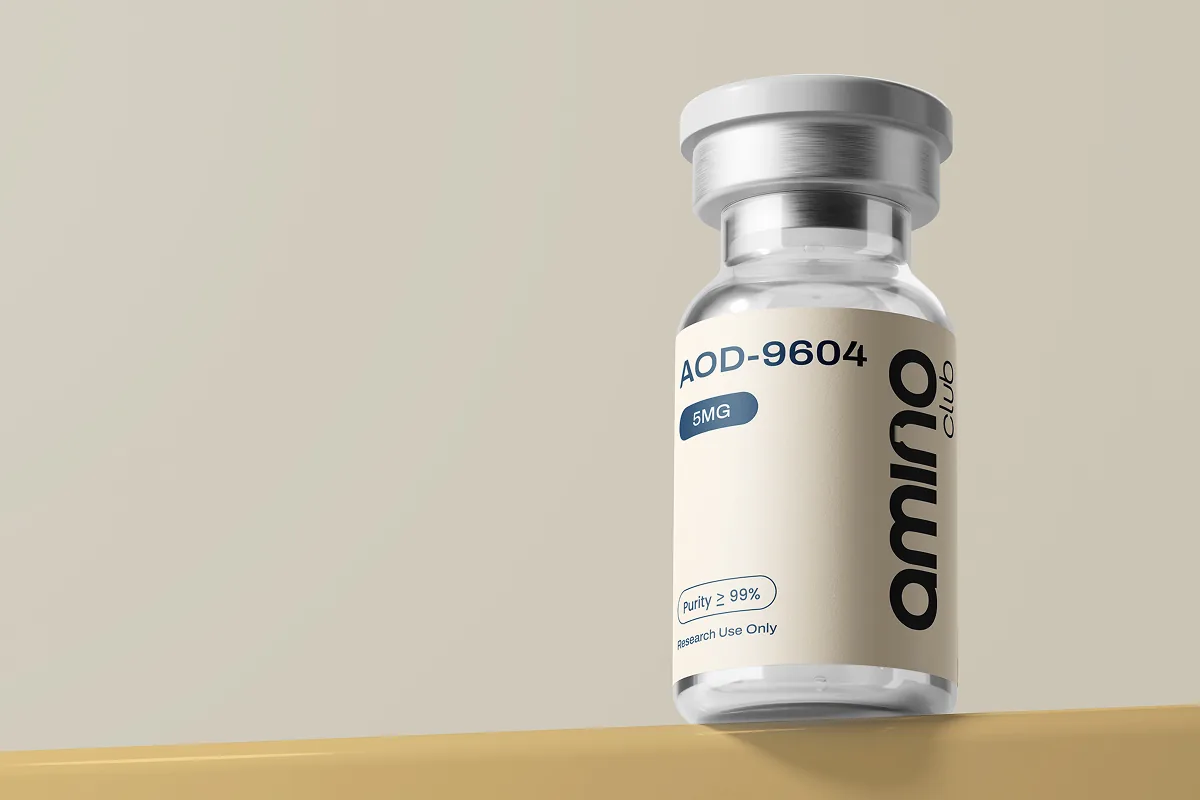
The C-terminal fragment of human growth hormone, studied for fat metabolism without the growth-promoting activity of the full protein, and one of the few compounds here with a clear, largely negative, clinical record.
- Sequence
- Tyr-Leu-Arg-Ile-Val-Gln-Cys-Arg-Ser-Val-Glu-Gly-Ser-Cys-Gly-Phe (Tyr + hGH 177–191), Cys7–Cys14 disulfide
- Molecular formula
- C78H123N23O23S2
- Molecular weight
- 1815.1 g/mol
- CAS number
- 221231-10-3
- Appearance
- white lyophilised powder
- Strengths available
- 2mg, 5mg, 10mg per vial
- Purity
- ≥99% by HPLC, identity confirmed by mass spectrometry
- Released against
- the Certificate of Analysis for its own batch
About AOD-9604
AOD-9604 corresponds to residues 177 to 191 of human growth hormone, with a tyrosine added at the N-terminus and a disulfide bridge between its two cysteines. It is widely listed as fragment 176-191, which refers to the same region under a different numbering convention.
The rationale is dissociation. Growth hormone has anabolic and growth-promoting effects mediated largely through IGF-1, and a separate effect on lipid metabolism. Early work localised much of the lipolytic activity to this terminal region, raising the possibility of a fragment that mobilised fat without raising IGF-1, without affecting glucose handling and without growth-promoting actions. The fragment does not bind the growth hormone receptor in the way the intact hormone does, which leaves its actual target incompletely resolved.
What the research covers
Work covers lipolysis and lipogenesis inhibition in adipocyte models, with beta-3 adrenergic receptor involvement proposed, supported by knockout-mouse work and contested elsewhere. A separate, smaller literature concerns cartilage and osteoarthritis models.
Its clinical history is the most useful thing to know about it. AOD-9604 progressed to human trials for obesity, the efficacy endpoints were not met, and development for that indication was discontinued in 2007. The in-vitro lipolytic findings are reproducible and the dissociation from IGF-1 appears genuine, so as a tool for interrogating the lipolytic arm of growth hormone action in a cell system it does what it is supposed to do. Summaries presenting it as an established fat-loss agent are not describing the trial literature. Comparative designs against full-length HGH 191AA are the most informative. Published work is indexed on PubMed.
Handling AOD-9604
Supplied lyophilised. A sixteen-residue fragment sits between the very short peptides and the larger proteins in robustness: less adsorption-prone than a tripeptide, less aggregation-prone than an acylated analogue.
Standard practice applies: gentle reconstitution against the vial wall, cold storage at -20°C, and solutions prepared fresh rather than cycled. Solvent options are under reconstitution supplies.
Common questions about AOD-9604
Is AOD-9604 the same as HGH fragment 176-191?
They refer to the same C-terminal region of growth hormone. AOD-9604 is residues 177-191 with an added N-terminal tyrosine, which is why both numberings appear.
Does AOD-9604 act through the growth hormone receptor?
Not in the way intact growth hormone does. Its actual target is not fully resolved, with beta-3 adrenergic involvement proposed.
What happened in human trials?
It was tested for obesity, failed to meet its efficacy endpoints, and development for that use ended in 2007.
What is it still useful for in research?
Studying the lipolytic activity of growth hormone separately from IGF-1-mediated growth signalling, especially alongside full-length growth hormone.
How should AOD-9604 be stored?
Sealed vials at -20°C. Solutions are reconstituted gently and prepared fresh.