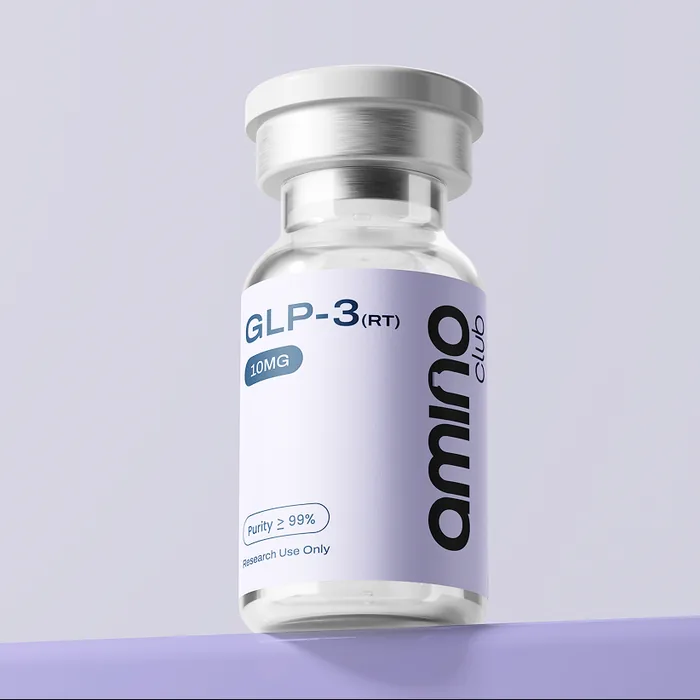
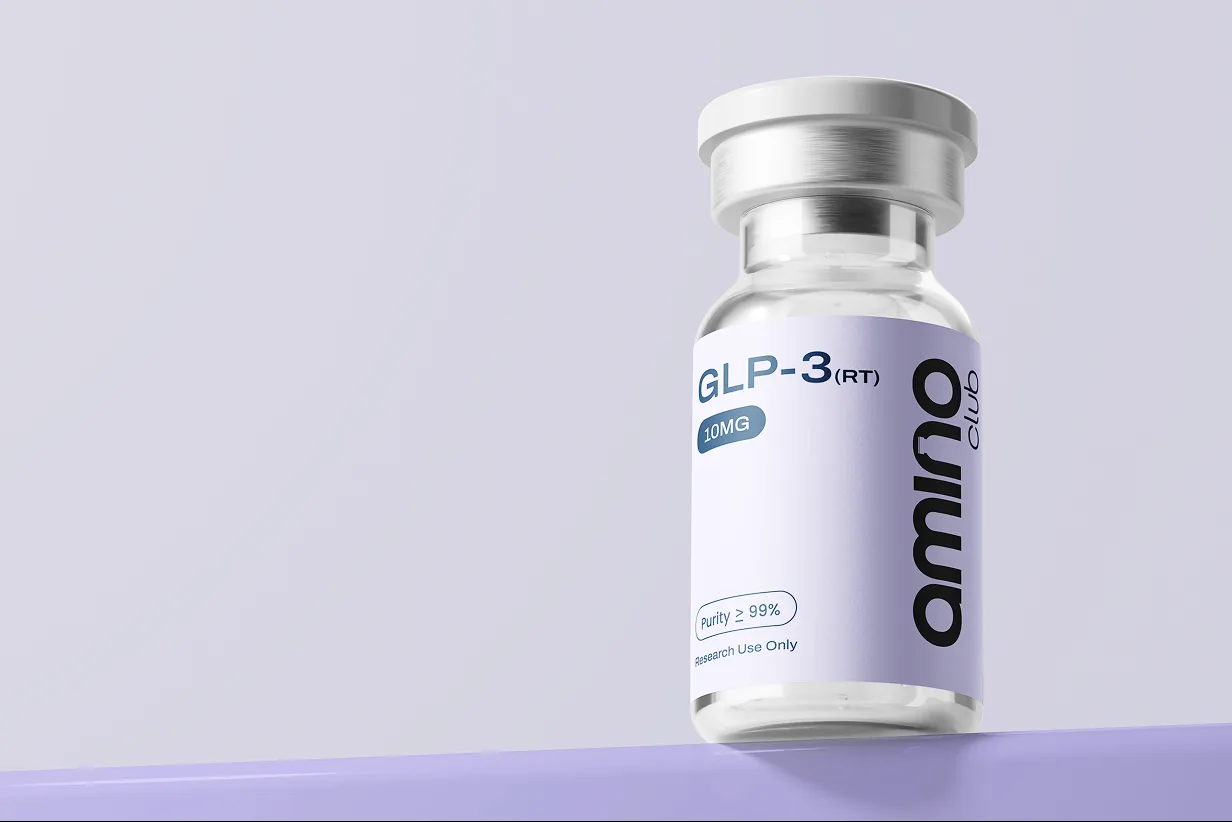
A triple receptor agonist, listed under a coded site name. GLP-1, GIP and glucagon receptor activity in one sequence — including the one that raises energy expenditure rather than lowering intake.
- Strength: 10mg
- Presentation: vial
- Purity: ≥99% by HPLC, identity confirmed by mass spectrometry
- Released against: the Certificate of Analysis for its own batch
- Reference: RT10
About GLP-3 (RT)
Triple agonists add glucagon receptor activity to the GLP-1 and GIP coverage of a dual agonist. The glucagon receptor is the interesting and counterintuitive inclusion: glucagon raises hepatic glucose output, which is the opposite of what the other two arms do, but it also raises energy expenditure, and the hypothesis is that the incretin arms offset the glycaemic effect while the expenditure effect is retained.
That makes the potency balance across three receptors unusually delicate, and it is the reason molecules in this class differ more from one another than the dual agonists do. This item carries a coded site name; identity for a given batch is available from research support.
What the research covers
Research questions centre on whether the three-receptor combination behaves as the sum of its arms. Endpoints include hepatic glucose output, resting energy expenditure, adipose lipid handling and hepatic lipid content, the last of which is where glucagon receptor agonism is of most interest.
Because the arms can oppose one another, dose-ranging and comparator design matter more in this class than in the single-receptor case, and results are not transferable between triple agonists with different potency ratios. The metabolic research peptides hub sets out how this group divides.
Handling GLP-3 (RT)
Supplied lyophilised. Handling follows the rest of the acylated incretin class: aggregation in solution is the failure mode to design around, not hydrolysis.
Prepare solutions fresh, avoid agitation and repeated freeze-thaw, and treat a solution that has become even slightly turbid as compromised rather than usable. Solvent options are under reconstitution supplies.
Common questions about GLP-3 (RT)
Why add glucagon receptor activity?
Glucagon raises energy expenditure and acts on hepatic lipid. The incretin arms are intended to offset its effect on glucose output.
Why do triple agonists differ so much from each other?
Balancing potency across three receptors that partly oppose each other is delicate, so molecules with different ratios behave differently and results do not transfer.
Why is the compound listed under a coded name?
This catalogue lists it under a coded site name. Research support can confirm the specific molecular identity for a batch, together with its Certificate of Analysis.
How should it be handled?
Acylated incretin analogues are robust when dry but aggregate in solution. Reconstitute gently, do not shake, prepare fresh and avoid freeze-thaw cycling.