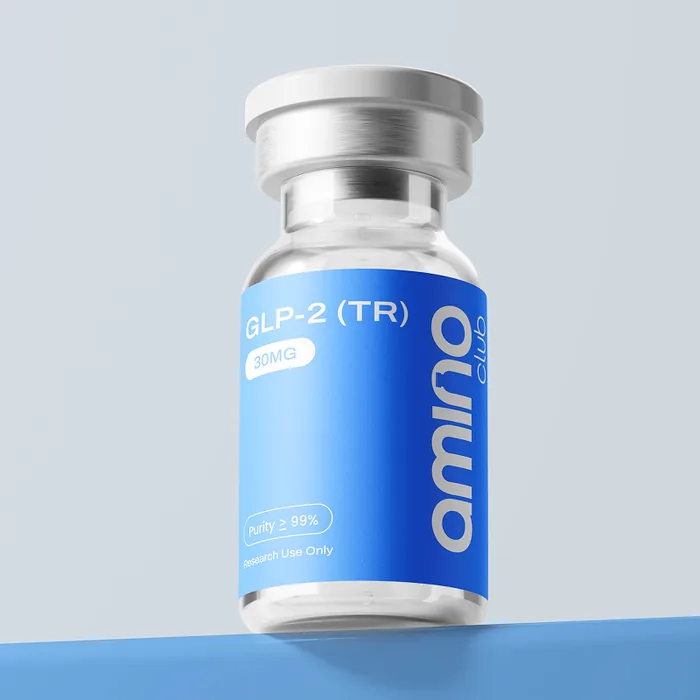
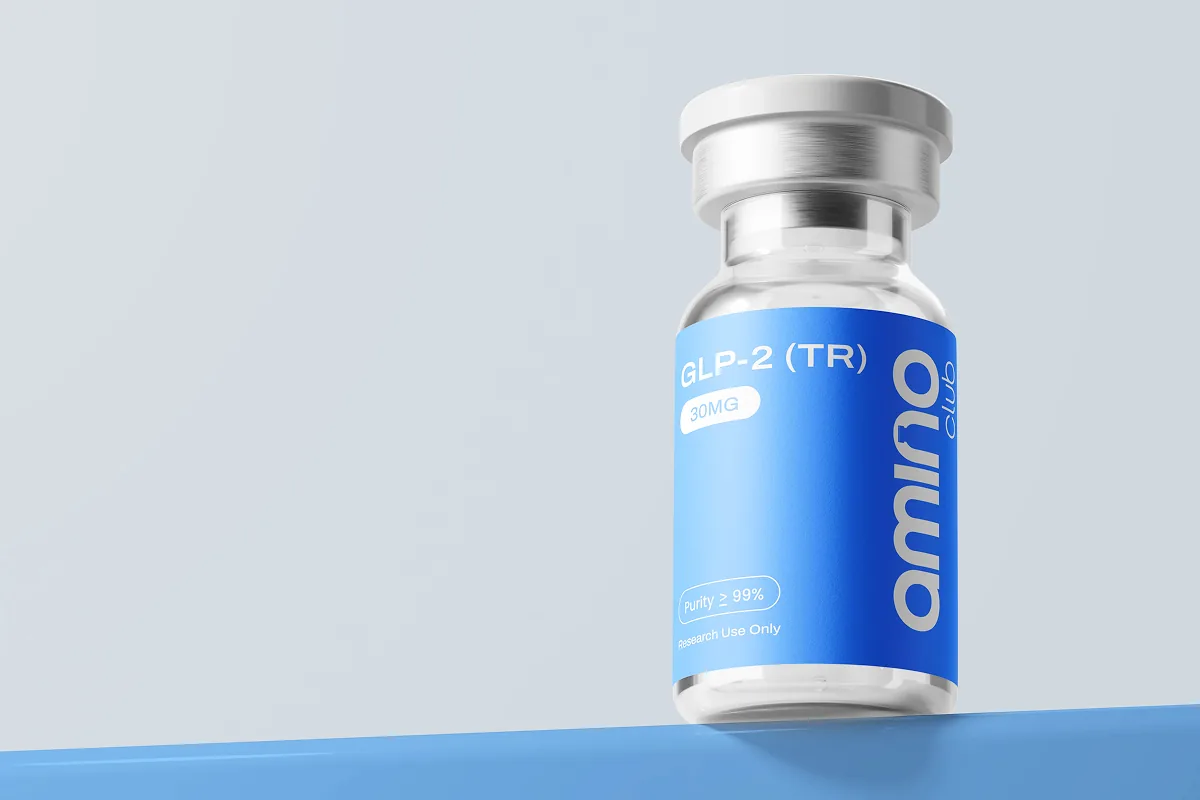
A dual receptor agonist, listed under a coded site name. Two incretin pathways engaged by one sequence, which is the whole point of the molecule.
- Strengths available: 5mg, 10mg, 15mg, 20mg, 30mg, 40mg, 50mg, 60mg, 80mg, 90mg, 100mg, 120mg
- Presentation: vial
- Purity: ≥99% by HPLC, identity confirmed by mass spectrometry
- Released against: the Certificate of Analysis for its own batch
About GLP-2 (TR)
Dual agonists in this class engage both the GLP-1 receptor and the glucose-dependent insulinotropic polypeptide (GIP) receptor with a single sequence. GIP is the other major incretin, released from intestinal K-cells, and its receptor has a different tissue distribution from the GLP-1 receptor — notably in adipose tissue, where GLP-1 receptors are sparse.
Engineering one peptide to activate two related but distinct class B GPCRs is a structural problem rather than a matter of combining two drugs, and the balance of potency between the two receptors is a design parameter that differs between molecules in this class. This item is listed under a coded site name; research support can confirm identity for a specific batch.
What the research covers
Work here concentrates on what the second receptor adds. GIP receptor signalling in adipocytes affects lipid handling in ways GLP-1 agonism does not reach, and whether the combination is additive, synergistic or partly offsetting is an open question that depends on the potency ratio of the particular molecule.
Comparative designs are the norm: a dual agonist is usually run alongside a single-receptor comparator and sometimes a triple, which is why the catalogue carries all three coverage levels. The metabolic research peptides hub sets out how this group divides.
Handling GLP-2 (TR)
Supplied lyophilised at a higher total mass than most of the catalogue, which makes accurate reconstitution volume more consequential — a small volumetric error at 30mg carries further than the same error at 5mg.
As with the rest of this class, aggregation in solution rather than chemical degradation is the practical risk. Swirl, do not shake; keep solutions cold and freshly prepared. Solvents are listed under reconstitution supplies.
Common questions about GLP-2 (TR)
What does a dual GLP-1 and GIP agonist add?
GIP receptor signalling, notably in adipose tissue where GLP-1 receptors are sparse. Whether the effect is additive depends on the molecule’s potency ratio.
Is this the same as glucagon-like peptide-2?
No. Despite the coded site name, this product is a dual GLP-1 and GIP receptor agonist. Glucagon-like peptide-2 is a separate intestinal hormone.
Why is the compound listed under a coded name?
This catalogue lists it under a coded site name. Research support can confirm the specific molecular identity for a batch, together with its Certificate of Analysis.
How should it be handled?
Acylated incretin analogues are robust when dry but aggregate in solution. Reconstitute gently, do not shake, prepare fresh and avoid freeze-thaw cycling.