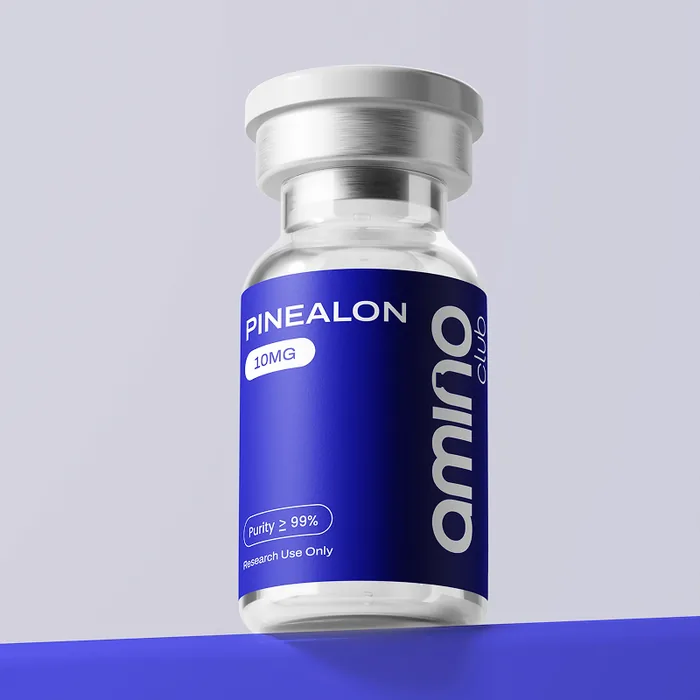
Three amino acids proposed to act on DNA directly rather than through a receptor: the clearest example in this catalogue of the short-peptide bioregulator idea.
- Sequence
- Glu-Asp-Arg (EDR)
- Molecular formula
- C15H26N6O8 (calculated)
- Molecular weight
- 418.4 g/mol (calculated)
- Appearance
- white lyophilised powder
- Strength
- 10mg per vial
- Purity
- ≥99% by HPLC, identity confirmed by mass spectrometry
- Released against
- the Certificate of Analysis for its own batch
About Pinealon
Pinealon is the synthetic tripeptide Glu-Asp-Arg, named for the pineal gland, from whose peptide fraction it was identified in the St Petersburg bioregulator programme that also produced Epithalon and Thymalin.
The proposed mechanism is what makes it unusual. Rather than binding a receptor, short peptide bioregulators are hypothesised to enter the cell and the nucleus and interact directly with specific sequences in DNA promoter regions or with histones, influencing transcription. The argument rests on complementarity between certain side chains and particular bases. For a tripeptide that is a strong structural claim, not settled outside the group that proposed it, and it is both the reason the compound is interesting and the reason it is contested.
What the research covers
Published work covers neuroprotection in hypoxia and ischaemia models, neuronal survival under oxidative stress, antioxidant enzyme expression, apoptosis in neuronal culture, and behavioural measures in aged or stressed animals. The proposed nuclear mechanism is addressed mainly through transcriptional readouts rather than direct binding studies, and much of the work comes from the originating programme.
What is missing is independent replication at scale and any modern clinical trial literature. At three residues, two of them acidic, this is a very small, highly charged molecule, which raises the question of how it would cross membranes for the proposed mechanism to operate at all. The appropriate posture is to treat published findings as hypotheses and include controls that distinguish a genuine transcriptional effect from a non-specific one. Published work is indexed on PubMed.
Handling Pinealon
Supplied lyophilised. A charged tripeptide is at the high end of adsorption risk and the low end of retention in dilute solution, so loss to container surfaces is the dominant practical error.
Use low-binding plasticware, keep dilution chains short, and prepare working solutions immediately before use. Store sealed vials at -20°C. Solvent options are under reconstitution supplies.
Common questions about Pinealon
How is Pinealon proposed to work?
As a short-peptide bioregulator that enters the nucleus and interacts directly with DNA or histones to influence transcription, rather than acting through a membrane receptor.
How well established is that mechanism?
It is a hypothesis with supporting experiments, mostly from the originating group, and lacks independent replication at scale.
Where does Pinealon come from?
It was identified from a pineal peptide fraction in the St Petersburg bioregulator programme, which also produced Epithalon and Thymalin.
Why does its small size raise questions?
At three residues and highly charged, it is unclear how it would cross membranes efficiently enough to act in the nucleus.
How should Pinealon be stored?
Sealed vials at -20°C. Working solutions are made immediately before use in low-binding plasticware.