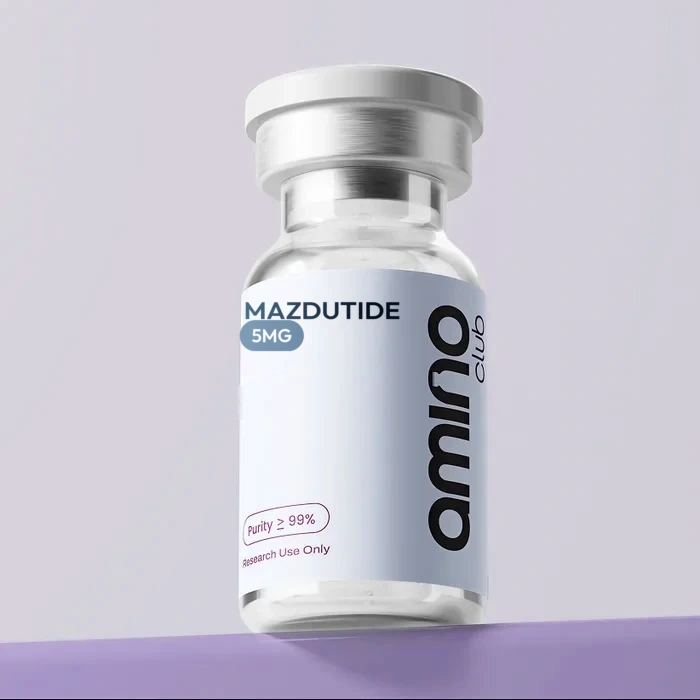
A GLP-1 and glucagon receptor co-agonist built on oxyntomodulin rather than on GLP-1 — a different structural starting point from the incretin-derived duals.
About Mazdutide
Mazdutide is a co-agonist at the GLP-1 and glucagon receptors, derived from oxyntomodulin. Oxyntomodulin is a naturally occurring proglucagon product that activates both receptors already, so the engineering problem here is extending its half-life and tuning the potency ratio rather than creating dual activity from a single-receptor parent.
That origin distinguishes it from GIP-containing duals: the second receptor is glucagon rather than GIP, and glucagon receptor agonism raises energy expenditure and hepatic glucose output rather than affecting adipose lipid handling.
What the research covers
Research centres on the balance between the two arms. GLP-1 agonism suppresses intake and improves glycaemia; glucagon agonism raises expenditure but works against the glycaemic effect, so the potency ratio determines whether the net result is useful. Hepatic lipid content is a frequent endpoint because the glucagon arm acts directly on the liver.
Survodutide occupies the same mechanistic space with a different ratio, which makes the two a natural comparison pair. The metabolic research peptides hub sets out how this group divides.
Mazdutide specification
- Strengths available: 5mg, 10mg
- Presentation: vial
- Purity: ≥99% by HPLC, identity confirmed by mass spectrometry
- Released against: the Certificate of Analysis for its own batch
Handling Mazdutide
Supplied lyophilised. As an acylated long-acting analogue it is stable dry and aggregation-prone in solution, with agitation and freeze-thaw cycling the two things most likely to spoil a preparation.
Swirl rather than shake, keep solutions cold, prepare them fresh, and discard any that has gone turbid.
Solvent options are under reconstitution supplies.
Further reading: the Mazdutide guide in the Amino Club research library covers the mechanism and the published work in more detail.
Certificates, delivery and terms
This batch ships with the Certificate of Analysis carrying the batch number printed on its label; how that is tested and released is set out on the lab testing page. Delivery, customs and returns are covered on the shipping page, common questions on the FAQ, and quantity pricing through bulk and wholesale. Supplied for in-vitro laboratory research only: not a medicine, not a supplement, not for human or veterinary use, and no dosing or administration guidance is provided — see the research use policy.